Athens: A journey into the history of civilization
“I am not an Athenian or a Greek, but a citizen of the world” (Socrates quoted by Plutarch)
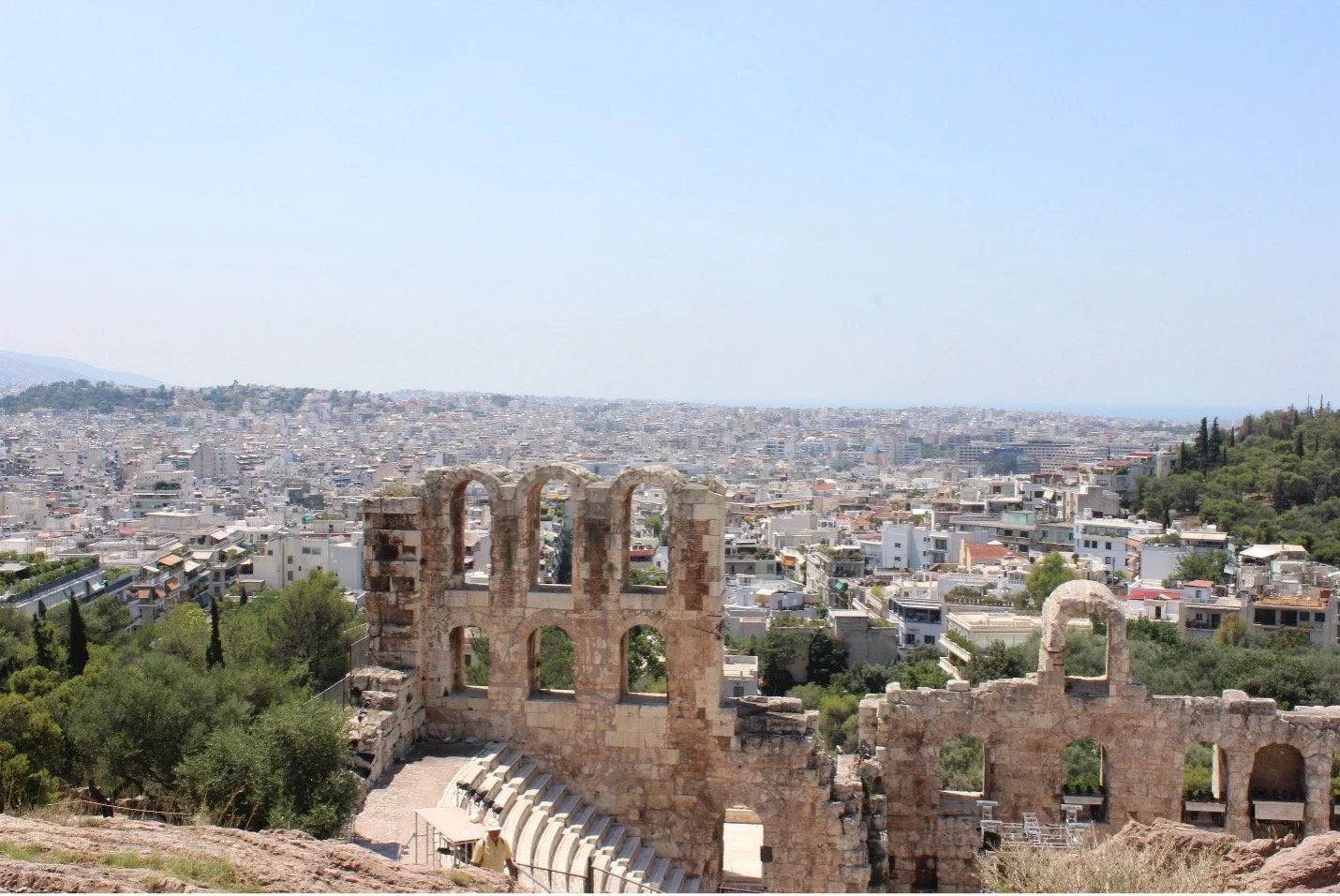
View of Athens from the Acropolis hill
Waking up in the heart of Athens to the view of the Acropolis, the iconic symbol of Ancient Greek Civilization and Western Humanism, sitting on a hotel rooftop with the church bells ringing on a Sunday morning prior to Kataklysmos (Whit Monday) is not just magical, it inspires a feeling of inner peace and gratitude that life can’t get better than this. It feels like a sacred moment perched between modernity and history in the city of Gods, Saints, Philosophers and infinite stories.
One church started ringing its bells, then another followed like a choir: first distant and faint, then growing into a sort of symphony across the city. Athens wakes up wearing its roots like an old lady dressed to go to the Sunday mass walking carefully between the past and the present, as the glassy towers intertwine with the ancient buildings. It is a rooftop morning where the spiritual, religious and historical heritage meet on Whit Monday, celebrated 50 days after Easter where the date changes every year (June 9th in 2025) symbolizing the Holy spirit descending on the Apostles.
No better way to start the day, coffee in hand and contemplating this dynamic mosaic, vibrant with locals, visitors, shoppers and artists mingling harmoniously in Monastiraki square where the smells of the famous Gyros and coffees fill the air.
And out there stood the magnificent Acropolis!
The Cradle of Democracy
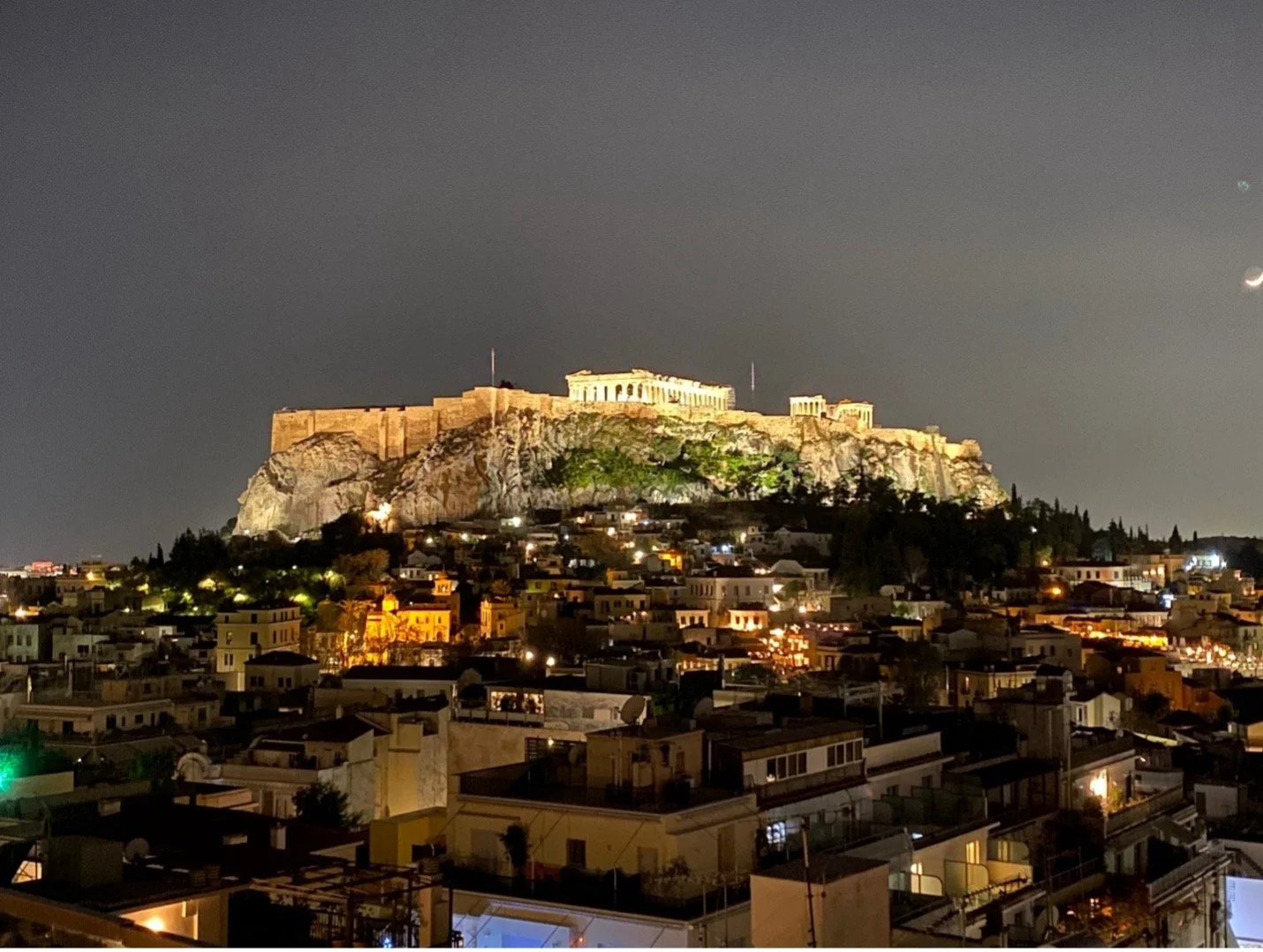
The Acropolis standing tall by night
The Acropolis and its main iconic structure, the Parthenon, reflect the classical Greek philosophy and arts which was built during the 5th century BC under Pericles. Athens and the Acropolis at its heart was the cradle of democracy and the home of the fathers of philosophy (Socrates, Plato and Aristotle) who shaped the ideas of human reason and freedom. The monument was a sacred place dedicated to Athena, the Goddess of Athens, and its temples blended the spirituality with the civic action. In the present time, the Acropolis stands as a living universal symbol of Western civilization that embodies democracy, shared human values and freedom.
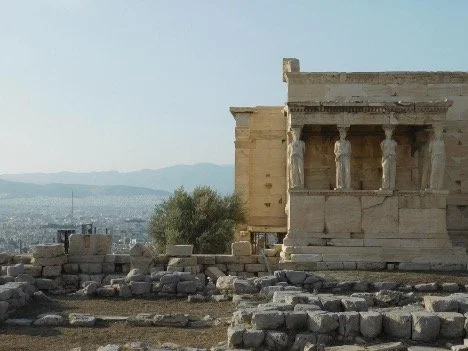
Part of the temple structures on the Acropolis
This silent sacred hill, a UNESCO world heritage site, is a witness of a history that shaped our own. Athens gave the world democracy, and on that hill, people first gathered to discuss ideas and debate the limits of power. In the inner walls of the Parthenon ran one of the most elegant artistic achievements of the ancient world, the Parthenon frieze, a band of marble stretching for about 160 meters, telling through stones a continuous story of the citizens of Athens: horsemen, musicians, elders and priests in dynamic movements.
Under the stars!
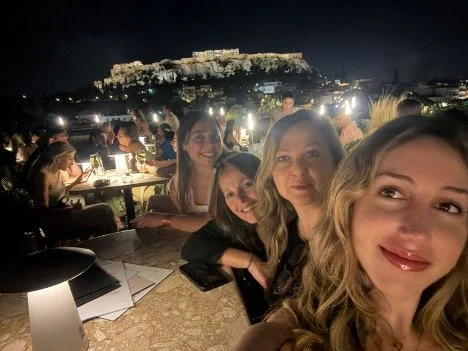
An evening out in Athens in the rooftop bar 360
Athens doesn’t get tired of the many people roaming the streets connecting the main shopping area in Ermou street and Monastiraki square or Plaka, and it becomes more sparkling at night with the decorating fairy lights all over the place. There is no better way to experience the nightlife in the city than enjoying a meal or a drink at a rooftop bar. Here above the peaceful neighborhoods, ancient and modern vibes mix as well enjoying a glass of prosecco under the stars and watching the Acropolis standing there unchanged except for wearing its beautifully illuminated façade while rhythmic tropical House music is being played. Truly unforgettable night!
The picturesque Plaka
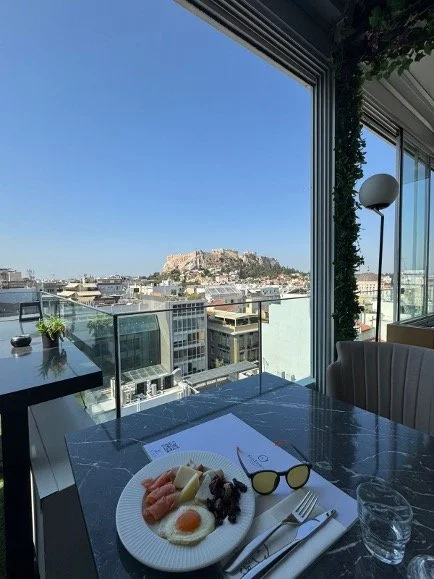
Breakfast on the rooftop of Elia Ermou hotel in the heart of Athens
Another day, another breakfast from the rooftop, before wandering in the streets of the old town Plaka, in the heart of the city. Below the streets were just beginning to stir. Plaka isn’t just picturesque, it’s vibrant with centuries of stories hidden between the ancient walls. People live it rather than just walk through its narrow cobblestone streets where bougainvillea flowers flow over ancient walls and ancient chapels stand on almost every corner. It is a myriad collection of shops selling handmade souvenirs depicting the Greek culture and inviting passers to discover the various artisan products. Simply walking and following the same footsteps of the grand philosophers who shaped our world, such as Socrates, Plato and Aristotle only to name a few, gives the place an everlasting charm.
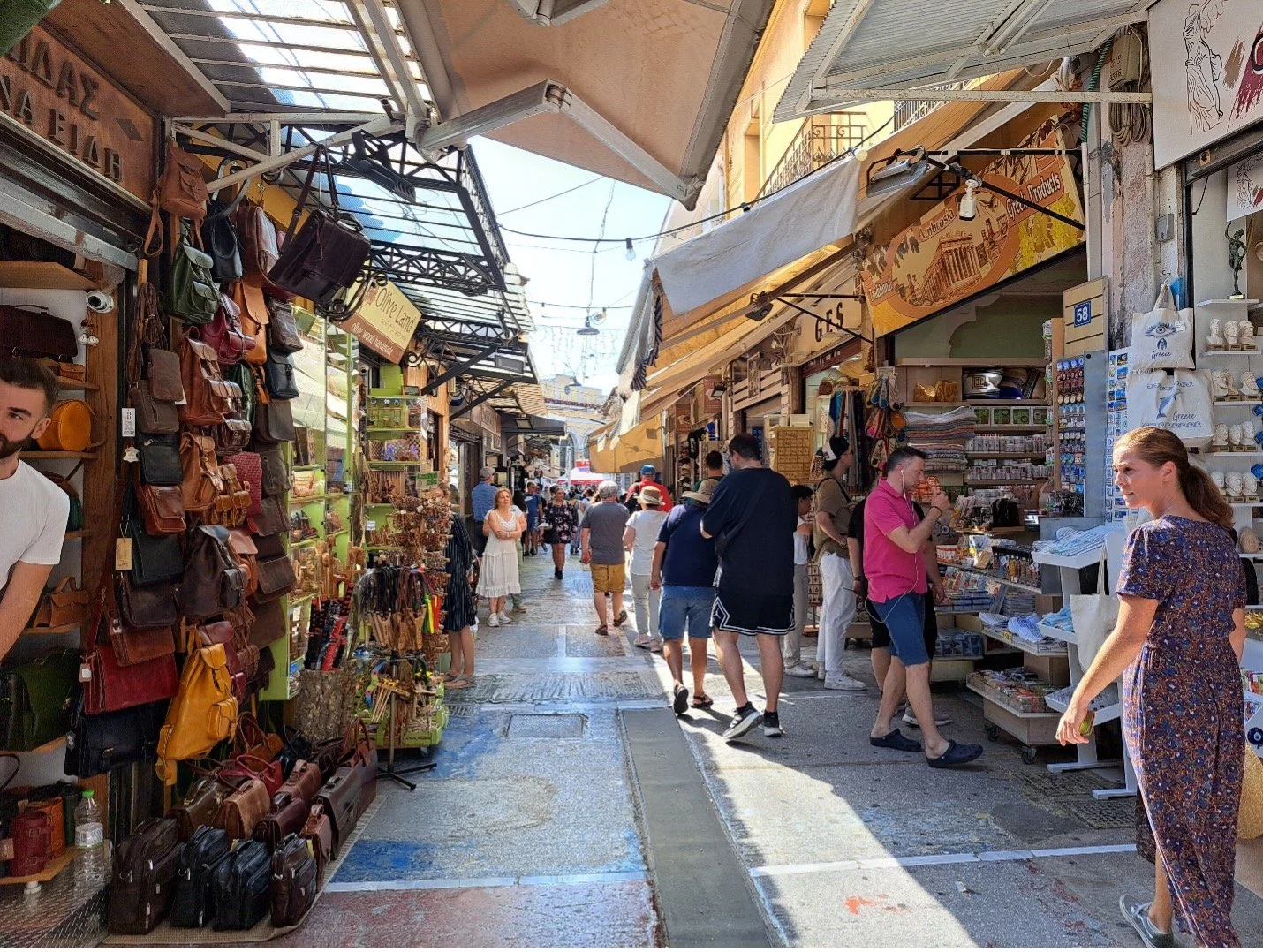
One of the busy streets of Plaka in the heart of Athens
The smell of grilled souvlaki fills the streets inviting visitors to step in where no visit is complete without indulging in the various taverns and enjoying the famous Greek salad, marinated gavros, tarama and tzatziki, as well as of course, a choice between the famous souvlaki or Gyros. To complete this gastronomic experience, it is almost imperative to end the meal with the aromatic digestif, the mastiha liqueur, coming straight from the island of Chios in the Agean Sea.
Time to pack and get ready for a new/old discovery.
Et voilà! Boarding the ferry to Mykonos … the island that never sleeps.
Five things to know about Athens?
Athens is named after Athena, the Goddess of Wisdom.
Population is around 3.15 million people.
Athens is one of the oldest cities in the world dating back 3,400 years.
The city hosted the first Olympic games in 1896 and then in 2004.
The olive branch became a symbol of the city after Goddess Athena planted the first olive tree on the Acropolis according to the Greek mythology.