From Suburbia to the Cedars: Back to the roots where it all began!
“We buckled our seatbelts and went for a ride. And what a ride it was! A trip of a lifetime is one way to describe it, and I am ever so grateful for all of it”.

The Cedars of God Forest near Bcharre in Northern Lebanon
With this sentence, my cousin Dolly, with whom I grew up as “long lost sisters”, started her social media post describing this emotional experience of crossing the ocean from the United States to her hometown in Lebanon to show her children where their mother came from and what shaped her life from an early age. She wanted to show them in person what’s in that world, not just in the photos or through the infinite stories they heard over family dinners and lunches, but to hear the stories, the sound of the actual place and get a taste of its unique flavors. Together we arranged this “Thelma and Louise” trip despite the logistical challenges. An emotional return to the roots, where the whole story began.
Connecting children to their family roots carries significant meaning that helps them develop a strong sense of identity and belonging especially if they visit their mother’s homeland accompanied by their grandmother and grandfather who took the decision to move the family to Clevland, Ohio in the United States of America in the peak of the Lebanese civil war in 1978. “Grateful that my children, all of them now, got to experience my homeland through the eyes of their Jeddo and Teta (grandpa and grandma)”. She was grateful that they will soon meet their family and experience their hospitality and endless generosity. Love so deep you can almost touch it, but no doubt you can feel it.
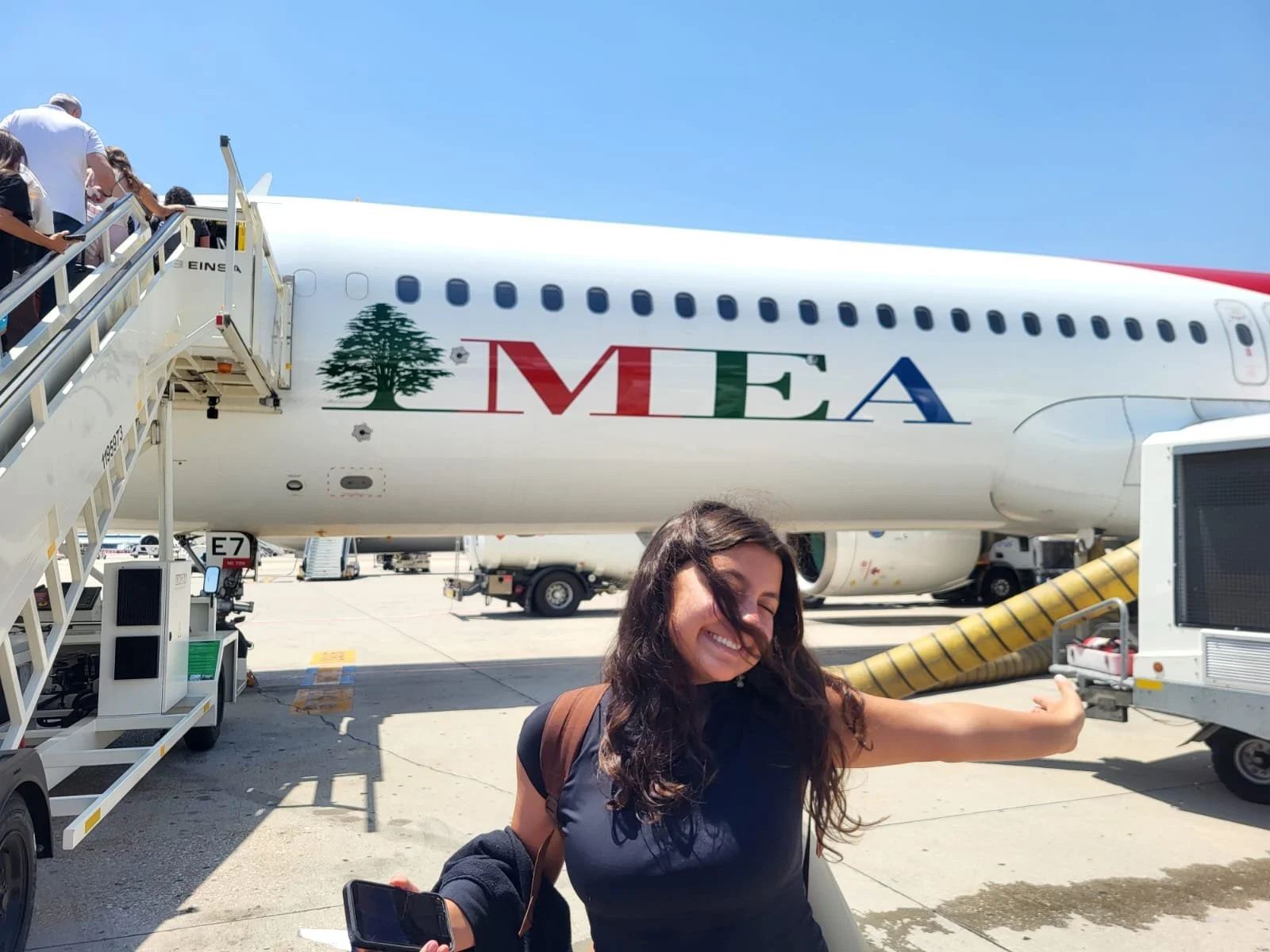
Boarding the MEA flight from Madrid to Beirut
Despite the fragile security situation and with mixed feelings of anxiousness and excitement, the four teenagers finally met members of the extended family whom they only heard of or have seen on video calls. Hence, started the journey of grasping every moment of that short stay in the country of Cedars. Nothing beats the Lebanese welcome, warm greetings from family members and endless tables full of all delicacies in a country where food culture is an expression of love and caring. My cousin Dolly wrote later on describing “this warm welcome all the family received once they set foot in Lebanon.”
A Bus filled with love … and many stories
First leg, a visit to the grandparents’ village of Aramoun surrounded by olive groves and ancient stone homes, where the family house still stands there but with different residents. Second leg is a day trip with the extended family to the Cedars of Lebanon, the national symbol of the country, around two hours’ drive from Beirut, in a bus full of love and warmth … and all the delicious goodies whilst listening to the traditional songs of the Lebanese Icon Fairuz.
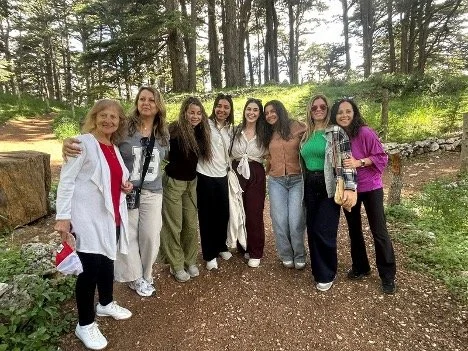
Family hike in the Cedars in June 2025
This trip to the Cedars, nestled near the village of Bsharri in northern Lebanon, is not just a visit to reconnect with nature but a cultural journey in history. Entering this ancient and mythical forest takes you in a moment of holiness where the Cedars of God stand in silence as the last vestiges of the forests that once covered Mount Lebanon. These trees are mentioned in the Epic of Gilgamesh and the Bible where the Phoenicians used their wood to build ships and King Solomon used them to construct his temple. Walking the trail through the grove, you find signs marking aging trees, including one thought to be over 2000 years old as well as signs of visits undertaken by public figures like the French High Commissioners during the colonial rule of Lebanon that stretched till independence in 1943, and specifically Henri Gouraud who proclaimed the State of Greater Lebanon in 1920 laying the foundation for the modern Lebanese Republic.
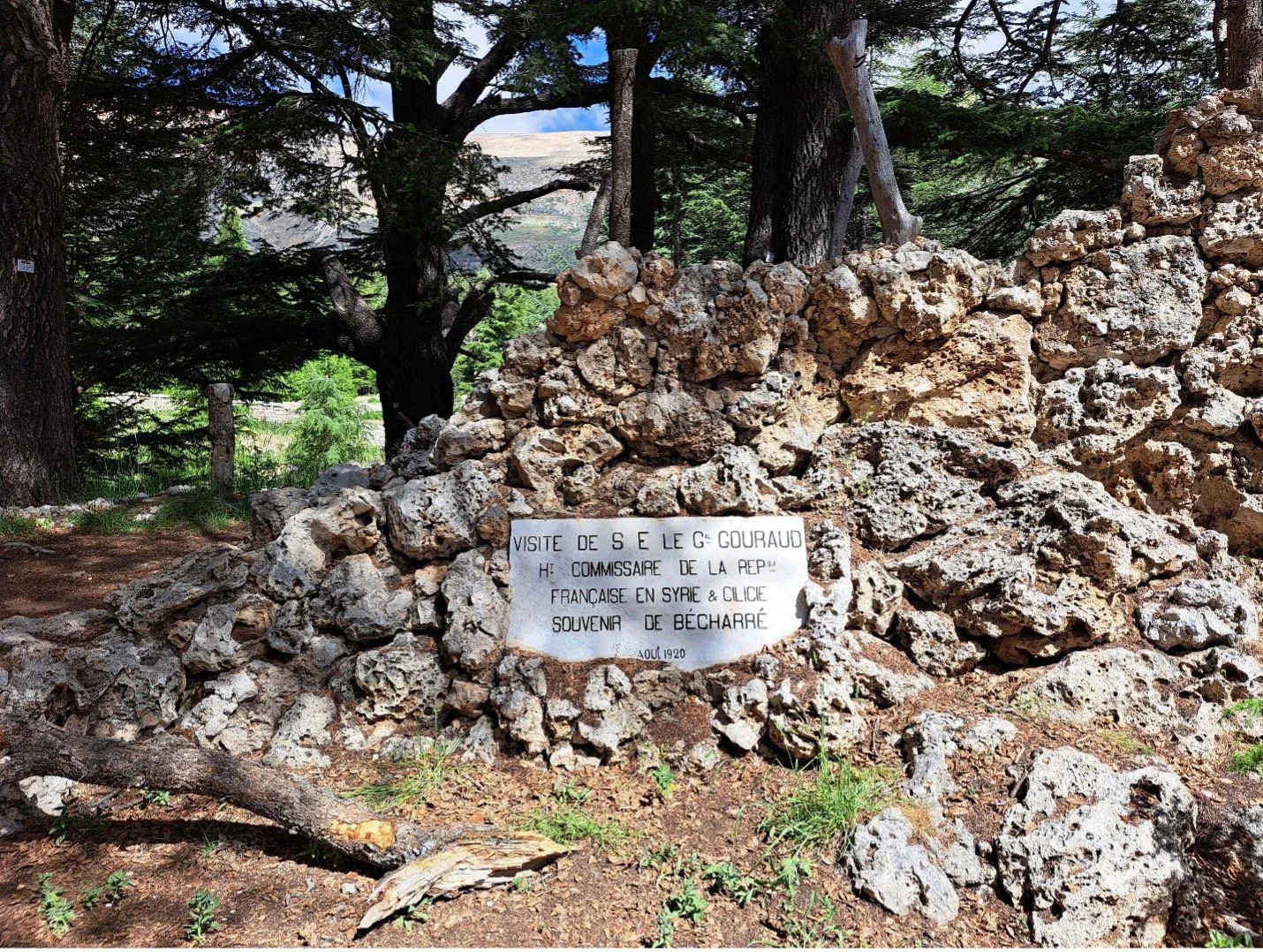
A sign under a cedar tree stands as a souvenir of the visit of the French High Commissioner General Henri Gouraud in August 1920
Part of the identity
No trip to Lebanon is complete without touring downtown Beirut where modernity blends with historical architecture, or having breakfast in the Zaytouna Bay area overlooking the marina, or even visiting the Iconic campus of the American University of Beirut where some buildings are located on a hill overlooking the Mediterranean Sea on one side near the long corniche: the scenic seaside promenade that stretches along 4.8 km approximately of the coast of Beirut.
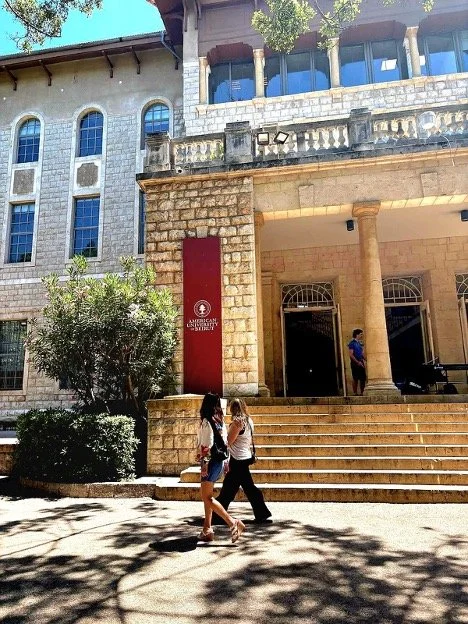
A walk in the beautiful historic campus of AUB
Along that promenade stands also the iconic natural rock formations in the sea named Raouché, the obligatory fun stop for photo shoots. Off to Mount Lebanon for another must see spot, the popular Christian Shrine of “Our Lady of Lebanon” in Harissa with an altitude of 650 meters above sea level and overlooking the bay of Jounieh with panoramic views of the Mediterranean Sea. From Harissa to Byblos, one of the oldest continuously inhabited cities in the world. Starting from the old port in the heart of the ancient city, which is stone built and lined with fishing and tour boats where a short coastal trip is indispensable to enjoy the scenic Phoenician heritage such as the harbor castle and medieval walls.
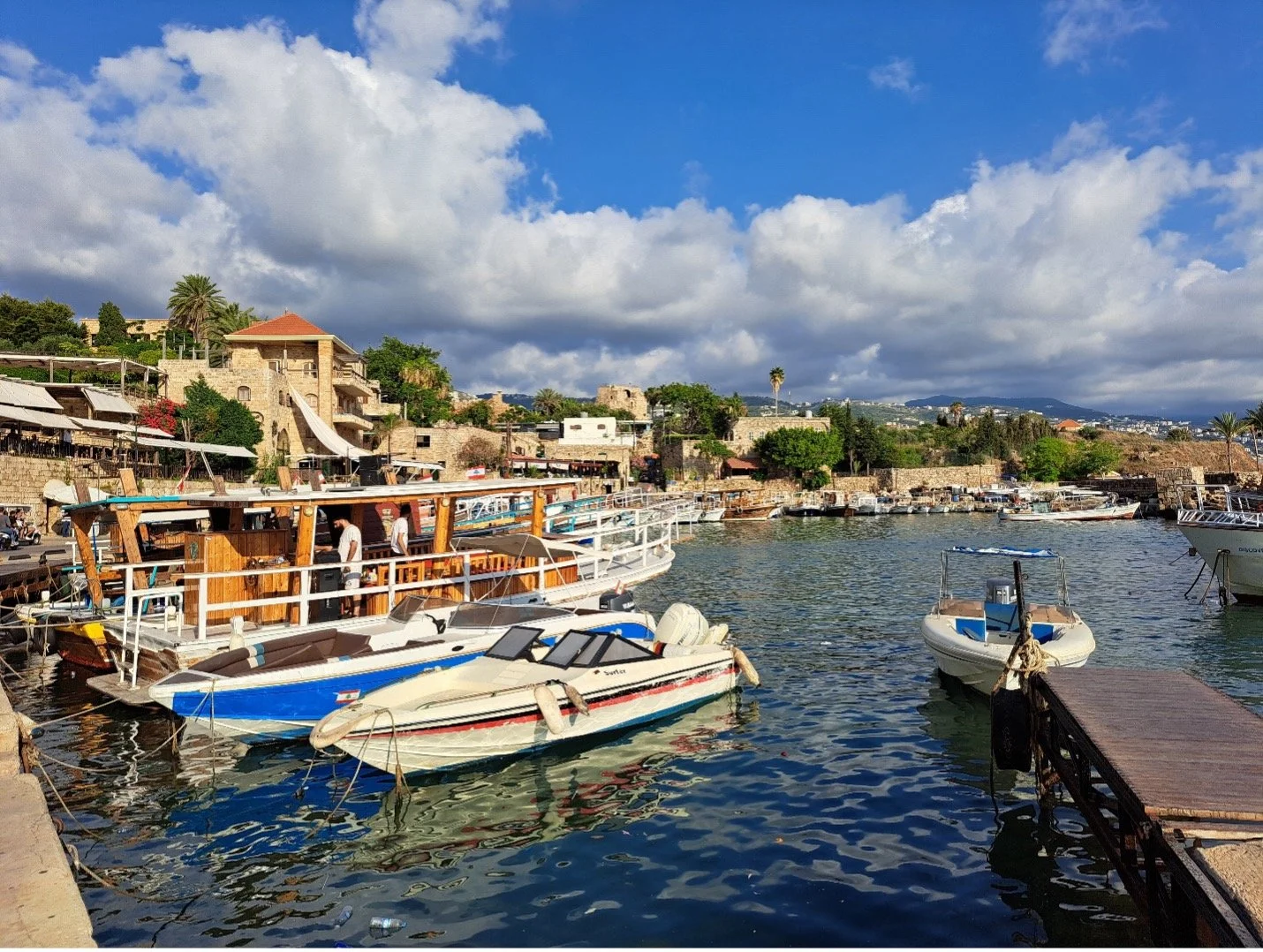
The old harbor of Byblos
“I want them to see it all”, said my cousin. After all she is not just showing them the places but part of herself, she wanted them to feel the warmth of the narrow streets that stand there in contrast to the spacious neighborhoods of suburban America. Everyone here is greeted by name, it is a culture that shaped every part of this family. Moreover, the laid-back attitude that characterizes in general the Mediterranean region is in stark contrast with the fast pace of life in the United States: this brings admiration but at the same time highlights the huge differences in the lifestyle. One of my cousin’s daughters, Amelia, said that “the US culture is very different. We are taught from a young age that we must work hard to make it to college and then start working and making tons of money. We don’t get much time to spend with our families,” and then she continued saying “while as in this part of the world people seem to be happier with less and they don’t have to compete to be the best of the best. It seems life here takes a calmer turn, more relaxed and less stressful”. Her mother smiled knowingly and replied saying that immigrant families in the US usually work harder because they “want to prove to their families that they did the right decision by moving out and having new beginnings”.
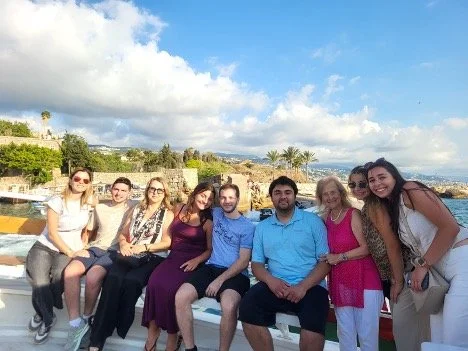
A boat trip from Byblos harbor
Sunset in Batroun
From Byblos to the nearby coastal town of Batroun, further up north and one of the must see places during this tour. Of course and as expected, the first thing we had to do before watching the sunset was enjoying the favorite Lebanese food: Tabbouleh, Fattouch, Shawarma, Kebbeh and Baba Ghanouj: lunches and dinners here can stretch for hours. Next stop: the historical churches in this coastal city, among them St. Stephen’s Cathedral which was built in 1910 over an older church and designed by Italian architect Giuseppe Maggiore with a mix of Byzantine, Roman, and Gothic influences. “Our Lady of the Sea” (Saydet El Bahr/Miraculous Lady of the Sea) is another landmark which was built in the 19th century on the ruins of another structure and located along the sea near Batroun’s Phoenician Wall. It is here where my cousin and I took the same photo we took couple of years ago in what I call a memorable remake of a memorable lapse of time!
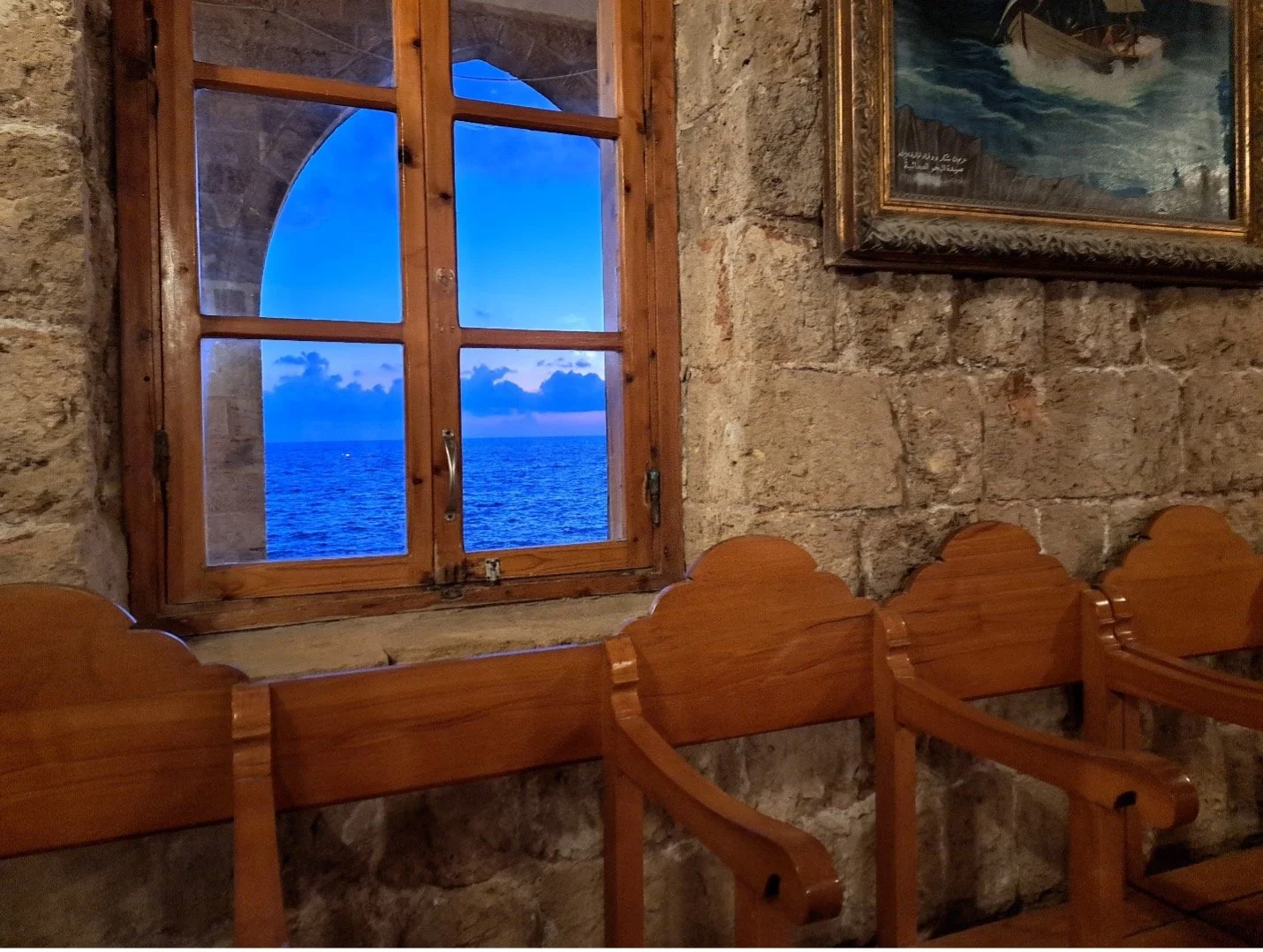
The Greek Orthodox church “our lady of the sea” overlooking the Phoenician wall in Batroun
Time to say goodbye
This trip was not just about travelling or going on vacation, it was a bridge, a message saying that traditions are to be valued despite the differences, and that home can be held at heart despite the distances: it is the daily dilemma for all expats. My cousin was grateful more than ever that she managed to give her children this cherished part of her heart, a part that is here to stay proving that roots are entrenched deeper than language or geography. I was also grateful that I was part of all this emotional “back to the roots” journey as well as glad I met for the first time my beautiful Goddaughter Nadia, having been her spiritual Godmother from a distance. The children took off, going back to the US carrying more than souvenirs: they brought home stories, memories, smells and flavors that connect them to their heritage now, more than ever.
My cousin’s comments summarize it all in a few words “Beyond the difficulties continues to lie the undisputed jewel of the Middle East. Beautiful, breathtaking, exhilarating, yet heartbreaking and emotionally exhausting … all at the same time. Ugh. Lebanon”.
Et voilà! From historic sites in Lebanon, off to Athens, the timeless city built on history.
Five things to know about the Cedars:
The Cedar tree appears on the Lebanese flag and on the Middle East Airlines’ fleet, the flag carrier of Lebanon.
The Cedar tree plays a significant role in the Epic of Gilgamesh, especially in Tablet V, symbolizing the divine, the natural world and sacred boundaries that ought not to be touched.
Byblos is the Greek name of the coastal Mediterranean city known as Jbeil in Arabic and was named historically as Gebal by the Phoenicians. It was declared a UNESCO World Heritage Site in 1984.
Byblos is the birthplace of the earliest known alphabetic script which was developed in around 1050 BCE.
Beirut is one of the oldest cities in the world and was a major Roman legal center as it hosted the Berytus School of Law, one of the most prestigious in the Roman Empire.