Italian Cuisine Abroad: A Lebanese journey with Neapolitan Pizza at Center Stage
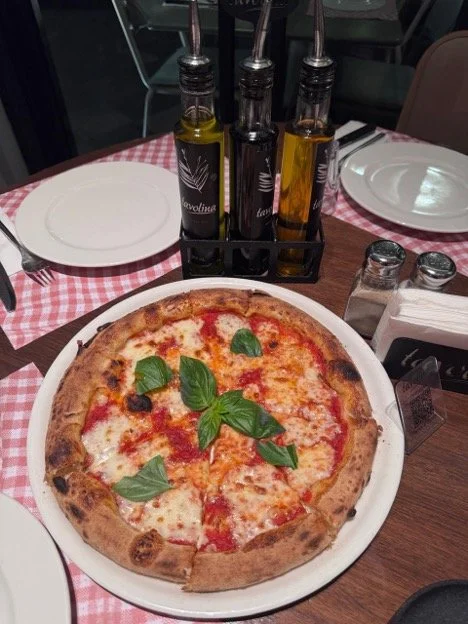
Pizza Napoletana
Italian cuisine is one of the most recognizable and celebrated food cultures in the world, rooted in simplicity, quality ingredients, and regional traditions. It has traveled far beyond Italy’s borders, adapting to local tastes while maintaining its unique identity.
Among the many countries that have embraced Italian food, Lebanon, which has one of the most popular cuisines in the world, offers an interesting twist which adds to the sense of comfort and familiarity that distinguish Italian cuisine.
Let’s embark on a journey to taste Italian dishes in Lebanon where the balance between authenticity and adaptation is a refined one, with the highlight being the Neapolitan pizza, loved all over the world and carries Italian traditions as a global language.
Italian cuisine in Lebanon is not a simple adaptation but rather evolves into a dialogue between two Mediterranean cultures.
Similarities
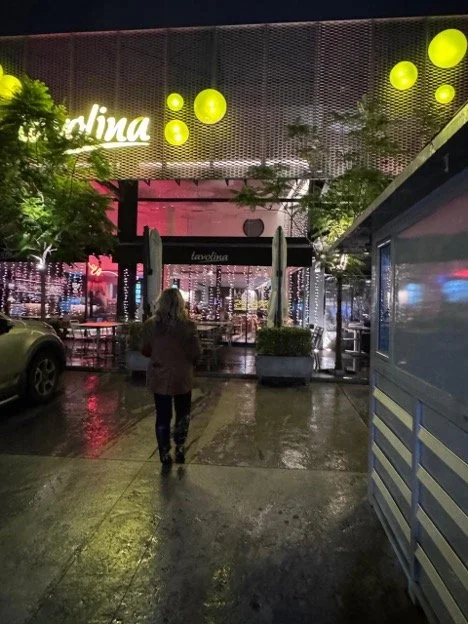
Entering Tavolina Italian Restaurant in Lebanon.
Lebanese and Italian cuisines share more than one might expect. Both cultures place strong emphasis on fresh, high-quality ingredients, seasonal produce, olive oil as a foundation and the importance of gathering and sharing food.
I met in Lebanon Mr. Dany Khairallah, the executive chef and one of the partners at “Tavolina” Italian restaurants, the authentic trattoria pizzeria, to speak about the Italian cuisine and how it is loved in Lebanon. We also had a tour in the kitchen to see the making of the star of the show: the Neapolitan (Napoletana) pizza where its craft and cultural tradition is officially inscribed by the UNESCO.
(Image of him taken from the close up short video of him, (the 25 seconds one)
The similarities between Italian and Lebanese cuisines integrate seamlessly into the Lebanese dining scene without losing the essence of the Italian traditions. Dany Khairallah said during our meeting in one of the Tavolina restaurants “we are not so far from the Italian table or the Italian mentality, because we have the mezze, and in Italy they have the antipasti, so it is somehow similar”.
He added that “Lebanese people travel a lot, and they have the knowledge of the Italian food which is why they love it and celebrate it. They also like to go out more, compared to other countries”.
“For all the family”
About the secret that attracts people to the Italian food, Dany Khairallah mentioned “it is the menu and the dishes” adding that “Italian cuisine is one of the best cuisines in the world, it is for all the family”.
With a long menu and many choices, he said “you can eat several times a week in an Italian restaurant: you have the pizza, risotto, pasta, antipasti and the secondi, like the meat. So, it satisfies all tastes”.
Furthermore, and according to Dany, the critical point at any restaurant is the quality which is exactly what they focus on at Tavolina by using “the best quality of Italian products” and providing a good atmosphere.
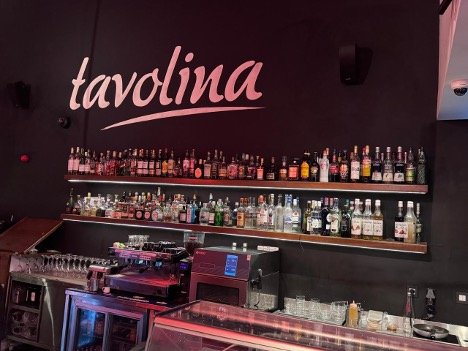
The Bar
“Cheesier”
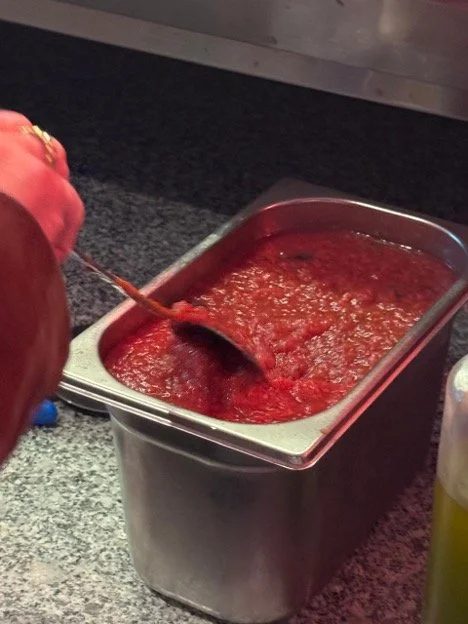
Fresh tomato sauce being prepared at the restaurant
How is Italian food adapted in Lebanon? The main twist is the cheese and the sauces!
When I asked the executive chef Dany Khairallah about the most important ingredient in the Italian cuisine, he stressed that “all ingredients are important for pizza as an example: first of all, the flour has to be Italian as well as the sauce for sure; the cheese is equally important for the Mediterranean people, because they like it cheesy”.
In comparing both tastes in Italy and Lebanon, he observed that “in Italy they put a bit of cheese on the pizza while as the Mediterranean people, they like it cheesier” adding that the secret of their success is trying “to have the mix between the Mediterranean taste and the Italian way”.
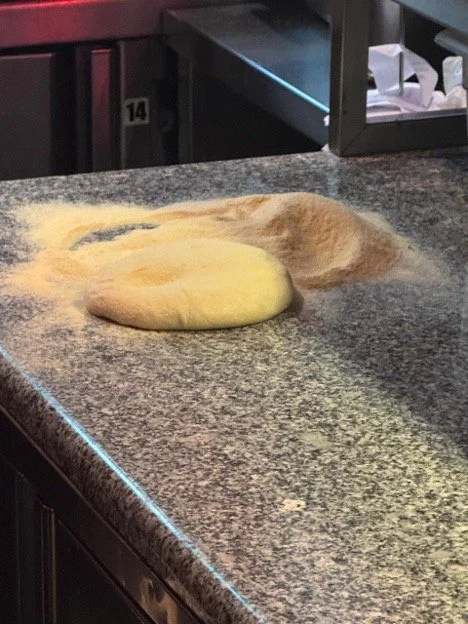
Preparing the dough for the pizza
So, how is it adapted? The twist comes through “the generosity of the toppings on the pizza. In Italy, they put more focus and importance on the sauce and the dough, followed by the cheese, whereby in Lebanon, they like the cheese more”, as Dany put it.
But what about the sauces? Are they adapted too? “of course,” he answered, “Mediterranean people like the sauces more than the pasta, which is different from the Italian taste as they like the pasta well combined with the sauce. However, here in Lebanon, the sauce takes on a whole different importance, hence why, we try to have the right mix”.
Following this nice chat with the chef, then came the time for some food tasting and the highlight was the Neapolitan pizza, thin and crusty with rich flavors of tomato sauce, the cheese, and the olive oil.
Pizza Napoletana
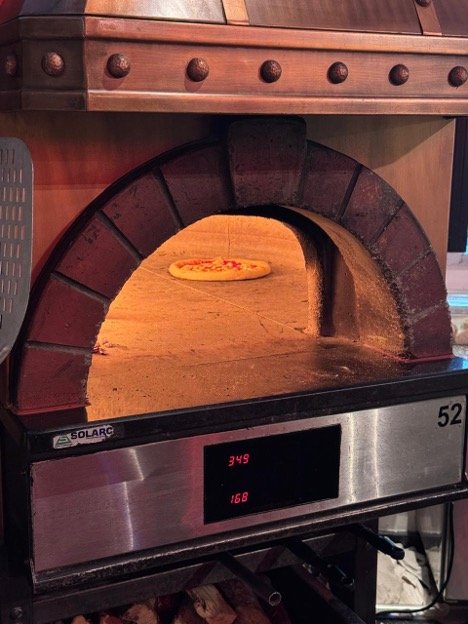
Pizza baking in the oven
Neapolitan (Pizza Napoletana) isn’t just food, it is a symbol of Italian culture and history. Originating in Naples, the capital of Campania Region (South) and the third biggest city in Italy after Rome and Milan, this pizza style is known for its simplicity and fresh ingredients.
It dates to the 18th century when Naples was a busy port, and workers needed a filling and affordable meal. It is defined by strict characteristics in terms of the dough and the classic topping composed of the Marzano tomatoes, mozzarella, basil and olive oil.
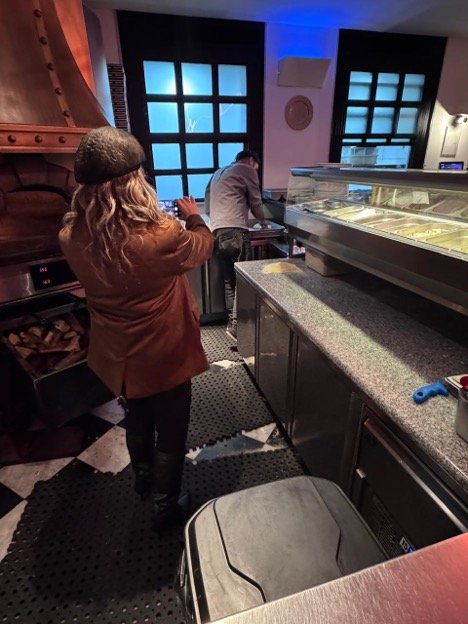
Watching the process of pizza making at Tavolina’s kitchen.
In December 2025, the United Nations Educational, Scientific and Cultural Organization (UNESCO) officially inscribed Italian cuisine on its Intangible Cultural Heritage of Humanity list, honoring the cultural and social traditions around Italian food, family meals and cooking skills through generations based on the seasonal produce.
To be noted that, the most iconic food of Naples gained UNESCO World Heritage status when it was inscribed in 2017 on the Representative List of the Intangible Cultural Heritage of Humanity for the craft of the traditional Neapolitan pizza making. UNESCO says on its website that the “art of the Neapolitan ‘Pizzaiuolo’ is a culinary practice comprising four different phases relating to the preparation of the dough and its baking in a wood-fired oven, involving a rotatory movement by the baker”.
Symbol of identity: A pizza moment!
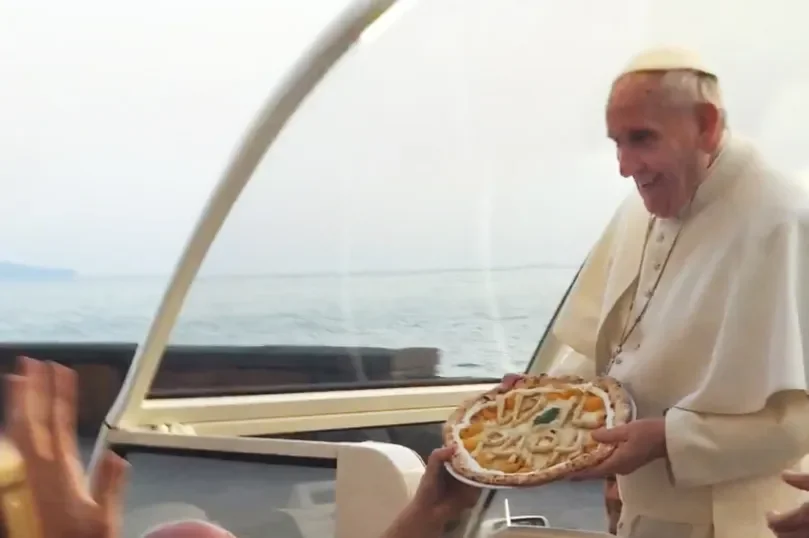
Pope Francis gets pizza in Naples
No gesture was more expressive of popular culture and identity than that of welcoming the late Pope Francis in Naples in March 2015 with a special pizza offered to him in his popemobile.
During this warm pizza moment on his pastoral one-day visit, Pope Francis was handed a pizza with the writing “Il Papa” on top of it and he willingly accepted it with a smile. It was also topped with yellow cherry tomatoes, as a sign of respect to the colors of the Vatican flag.
The pizza maker jumped outside the security barrier to hand the pizza to the pope as the crowds were cheering with joy to see the church meeting the daily habits of its people.
This moment of intersection between traditions and spiritual humanity brings a message that “this is who we are, and you are welcome at our table!”.
It is simply the art of sharing and mastering hospitality, the Mediterranean way!
Et voilà! Bon appétit everyone! Enjoy your Italian dish wherever it is!
Five facts about Italian cuisine:
Italian cuisine is regional coming from Italy’s 20 regions where each one has its own traditional dishes, ingredients, and cooking styles.
Simplicity is essential in Italian dishes. Usually, it is made of few ingredients giving priority to quality rather than quantity. Many recipes have fewer than ten components.
Italian food abroad is often adapted: spaghetti and meatballs or chicken Alfredo are creations of Italian communities abroad.
Italian food is based on seasonality; people cook with what’s available at a specific time of the year.
This cuisine is associated globally with a comfort feeling because it is warm, familiar, filling, and tied to human connection.