Paris spreads itself flat and magnificent in every direction, and then there is Montmartre, rising above it.
Montmartre is a neighborhood where art, music, and romance have flourished for centuries. It is a place where painters found inspiration, writers discovered their voices, and singers left their mark on history.
And then there was Dalida!

Dalida photographed in 1967. Photo credit: Brown/Rouget/DALLE
Let’s go on a tour of this unmatched hill together, and discover the square of this unique diva!
The Hill Above the City
Perched above the bustling streets of Paris, Montmartre, with its winding cobbled lanes, ivy-clad cafés, hidden gardens, and sweeping views over the City of Light, creates an atmosphere unlike anywhere else in the French capital.
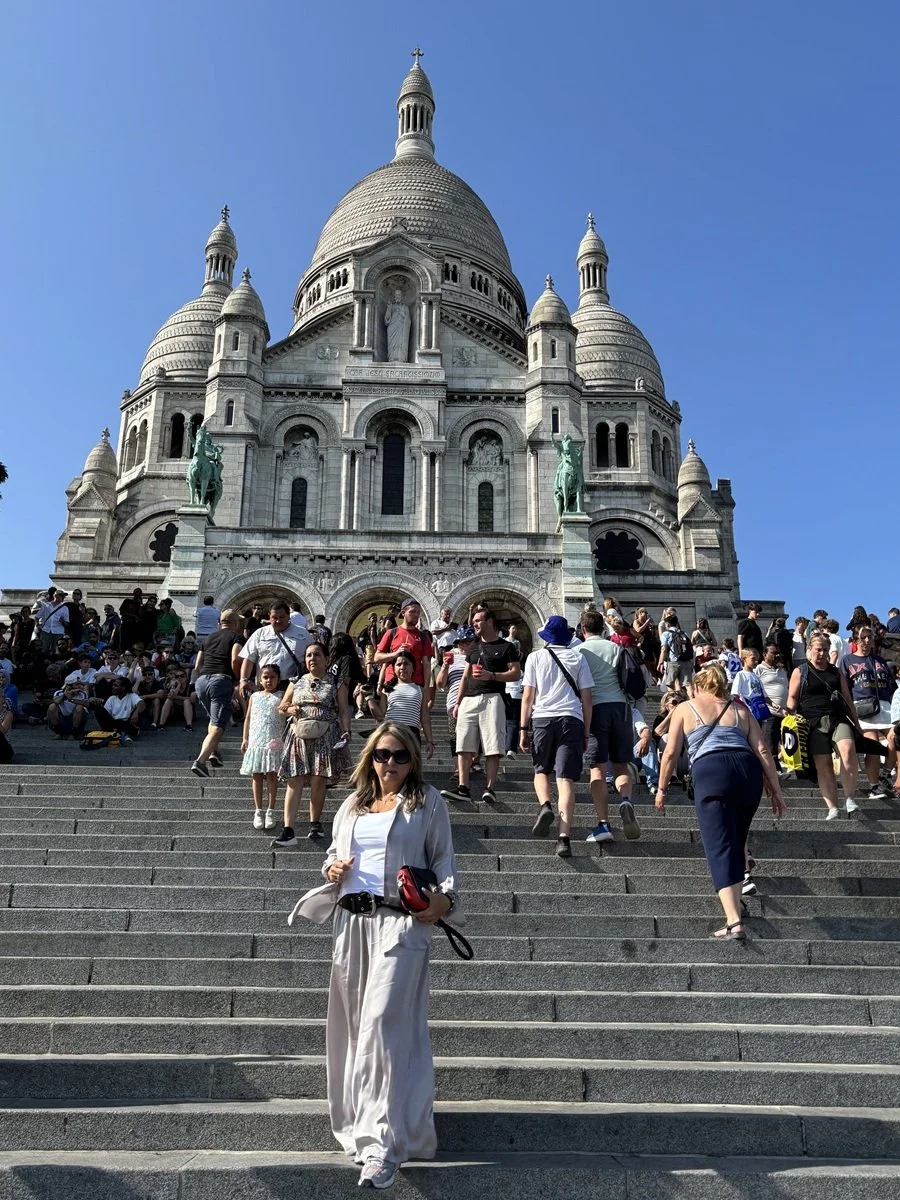
The steps to the famed Basilica may be steep, but each step carries you to a true Parisian landmark
The Sacré-Cœur Basilica sits at the top, white and improbable against whatever sky the day has decided to offer. Below it, the streets narrow, cobbled lanes, ivy-covered walls, staircases appear without warning, as well as small squares full of street art.
The Woman Who Became the Hill
There are places in the world where the people who passed through left something so permanent, so woven into the stones and the light and the particular angle of the afternoon, that you feel them still.
The French icon Dalida discovered the hill and never left. She found her true home in Montmartre.
She lived on the Rue d'Orchampt for the rest of her life. It was Montmartre's bohemian soul, touched by a gentle melancholy, which drew her in and made her feel at home.
The neighborhood suited her, and Montmartre became interlinked with Dalida.
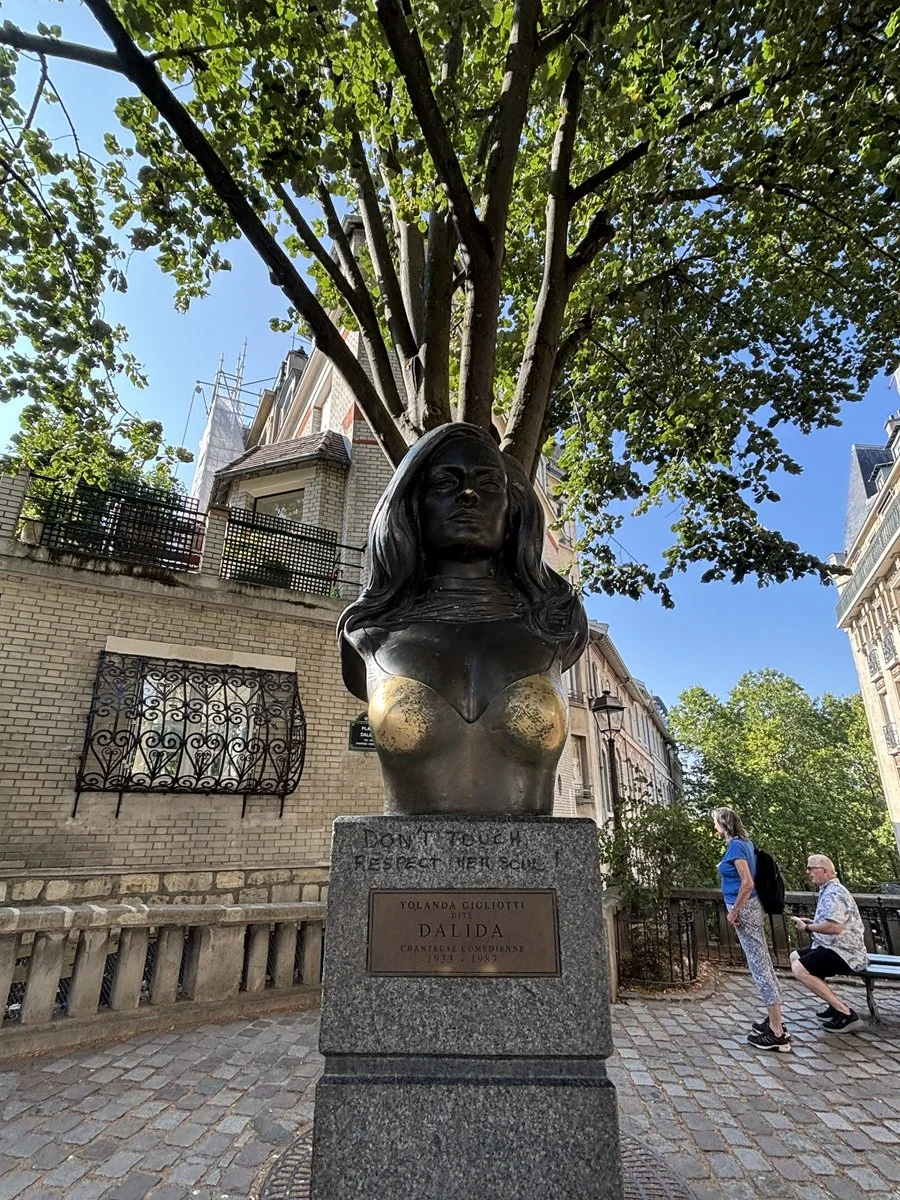
In the Montmartre square that carries her name, a bust of Dalida preserves her memory
Who was Dalida?
Born Iolanda Cristina Gigliotti in Cairo in 1933, the daughter of an Italian violin player, Dalida was raised between cultures, shaped by the particular displacement of someone who belongs completely to several worlds and not entirely to any single one.
She came to Paris in 1954 with a face that stopped conversation and a voice that stopped time. She won the Miss Egypt pageant. She spent much of her adult life in Montmartre where her presence is still woven into the neighborhood's charm.
She sold 170 million records across a career that spanned five decades in many languages, and she performed at the Olympia, at Carnegie Hall, at venues across the Arab world where she was received not as a foreign artist but as a daughter returning home.
And through all of it she came back to the hill, to the narrow street, to the house with the view.
The Square That Carries Her Name
At the bottom of the Rue d'Orchampt, where it opens into a small place, there is a square named after her.
At its center stands a bronze bust, her face in the permanent expression of someone who has just finished singing and is deciding whether to begin again. The bronze has been worn gold at the cheekbones by the hands of the visitors.
Around the square, the streets continue to do what Montmartre streets have always done, wind uphill, offer unexpected views, hide small cafés behind corners that reward the unhurried.
Tragic End
Despite her extraordinary success and international acclaim, Dalida's private life was marked by profound personal struggles with loneliness and loss of loved ones including romantic partners who died tragically.
On 3 May 1987, she died by suicide at her home in Montmartre. She left a brief note that read: "Life has become unbearable... Forgive me".
She is buried in the Montmartre cemetery, not far from the hill she made her home.
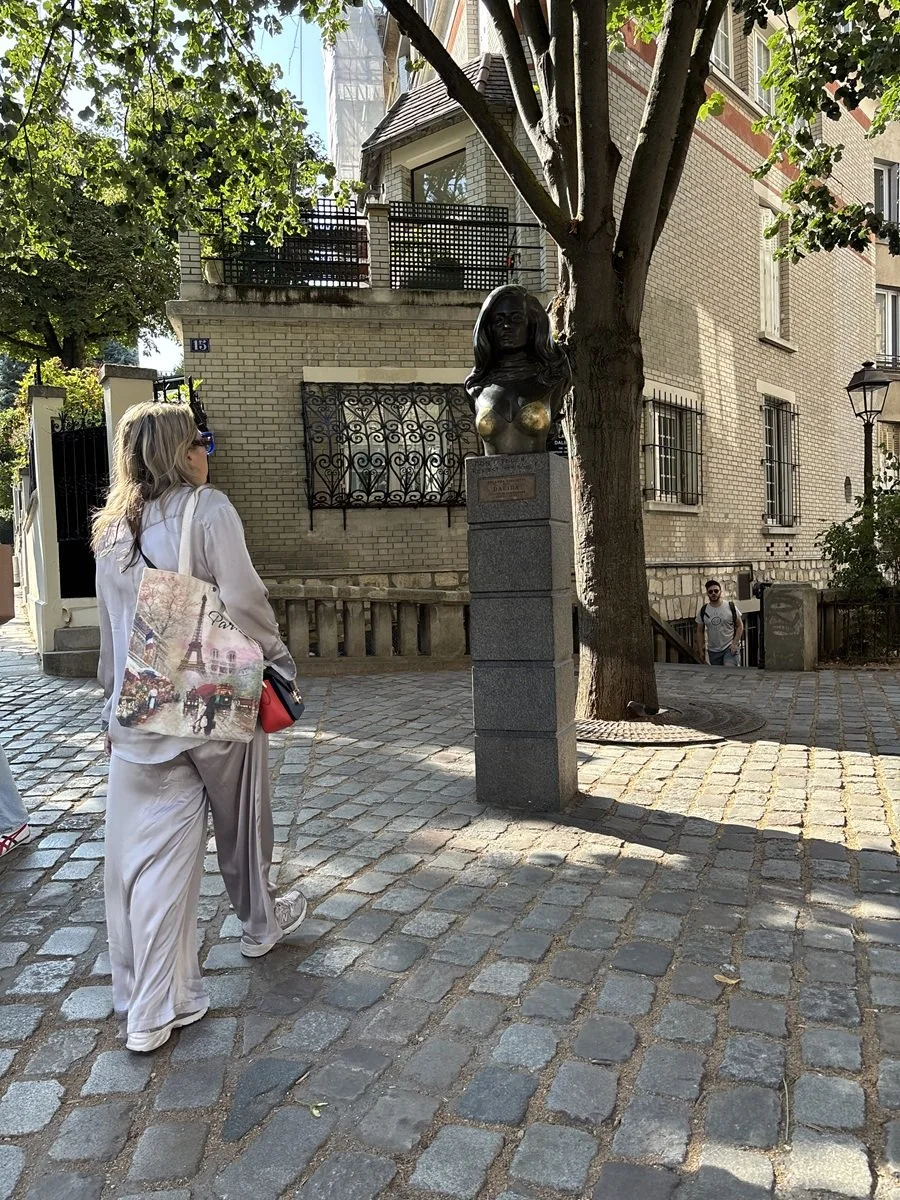
The tribute to the artist brings to mind her unforgettable, Mediterranean-infused songs
Final Word
This hill where I am standing now, following Dalida’s footsteps and discovering the soul of Montmartre, has always attracted the people who needed to be slightly above the world. Among them the icon Dalida.
Some artists leave behind songs. Dalida left behind a piece of her soul, forever woven into the timeless heart of Montmartre!
Let’s remember in the list below, some of this Mediterranean artist’s songs.
Et voilà! That was a nostalgic tour of Montmartre where another voice is deeply connected to it. In my next post, you will discover how the legendary Charles Aznavour saw Montmartre!
A List of Dalida’s Iconic Songs:
- Bambino (1956), the song that made Dalida a star.
- Gondolier (1957), a romantic Mediterranean-inspired song that reflected her Italian roots.
- Come Prima (1957), a beloved Italian song that became one of her early international successes
- Milord (1960), a dramatic chanson that showcased Dalida's powerful storytelling style.
- Les Enfants du Pirée (1960), "The Children of Piraeus", a Mediterranean classic that highlighted her ability to interpret songs from different cultures.
- Paroles, paroles (1973), one of her most recognizable songs worldwide, performed as a duet with Alain Delon.
- Il venait d'avoir 18 ans (1973), a deeply emotional ballad that became one of her greatest interpretations.
- Gigi l'amoroso (1974), a seven-minute theatrical story blending chanson, Italian influences, and dramatic performance.
- Salma Ya Salama (1977), a tribute to her Egyptian roots, blending Arabic and French influences.
- Laissez-moi danser (Monday, Tuesday) (1979), a disco-era hit that showed her ability to reinvent herself.
- Mourir sur scène (1983), one of her most dramatic late-career songs, reflecting her theatrical identity and powerful stage persona.
- J'attendrai (1975), a nostalgic interpretation that became closely associated with her elegant vocal style.
Five Facts About Montmartre:
1- Montmartre is the highest natural point in Paris, standing approximately 130 meters (430 feet) above sea level and until 1860, it was an independent village before being incorporated into the French capital.
2- The name Montmartre is believed to derive from the Latin Mons Martyrum ("Mount of the Martyrs"), referring to the martyrdom of Saint Denis, the first Bishop of Paris.
3- During the late 19th and early 20 th centuries, Montmartre became the heart of Paris’ bohemian movement, attracting artists and writers among them the legendary Pablo Picasso, Vincent van Gogh and Pierre-Auguste Renoir who lived or worked there.
4- The iconic Sacré-Cœur Basilica crowns the summit of Montmartre and offers one of the finest panoramic views over Paris
5- The historic Moulin Rouge, located at the foot of Montmartre, opened in 1889 and became the birthplace of the French can-can.