Les Deux Magots: The Café That Shaped Modern Thought
There are cafés in Paris and then there is Les Deux Magots.
The distinction matters, as a café in Paris is a place to drink coffee while as Les Deux Magots is a place where coffee arrives as a secondary consideration, the primary one being that you are sitting in the same room where the great thinkers sat
It is the place where Simone de Beauvoir wrote, Ernest Hemingway argued, Albert Camus thought, Pablo Picasso sketched on whatever surface was available, where Jean-Paul Sartre spent so many hours that the management eventually gave him his own corner table and presumably stopped asking if he wanted anything else.
How It Began?
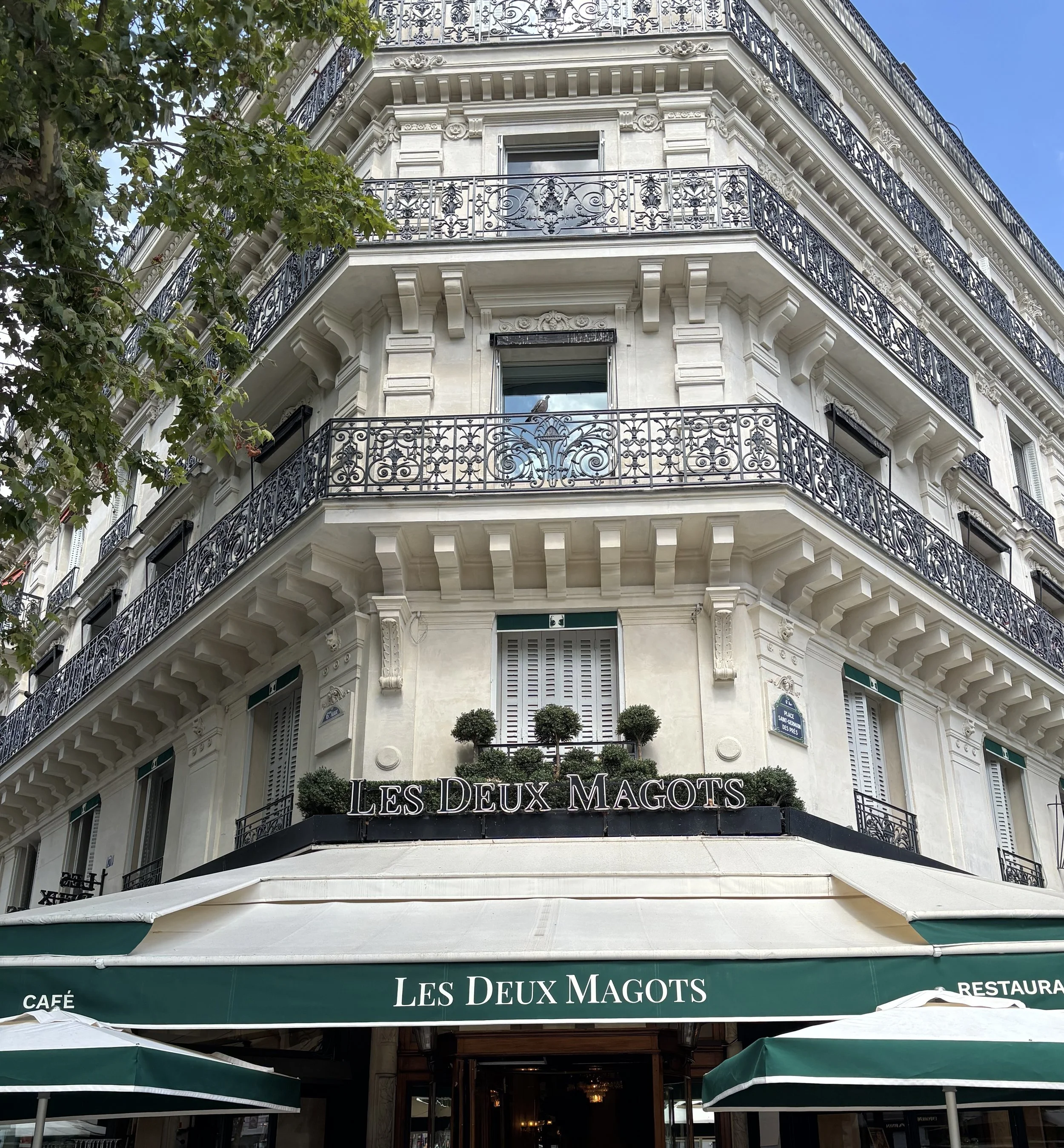
The building on the Place Saint-Germain-des-Prés has been a commercial premises since 1812, first a novelty shop selling fabrics and curiosities from China and the Far East, the kind of shop that existed in every European capital in the nineteenth century to satisfy the appetite for the exotic that empire and trade had created.
The name comes from this origin. Les Deux Magots, the two Chinese figurines, refers to the pair of carved wooden Chinese figures that sat above the shop counter and eventually, when the premises became a café in 1884, were moved to the columns inside the main room where they still sit today. Painted, lacquered, watching everything that has happened in this room for over a century.
The café established itself quickly as a gathering place for the literary and artistic community of Saint-Germain, a neighborhood that was, in the late nineteenth and early twentieth centuries, the intellectual center of Paris in a way that no single neighborhood in any city quite replicates today.
Writers, painters, philosophers, political exiles, and the entire apparatus of the Parisian avant-garde converged on Saint-Germain because the rents were cheap, the cafés were warm, and the management of establishments like Les Deux Magots understood implicitly that a writer nursing a single coffee for four hours was a better advertisement than a tourist who ate a full lunch and never came back.
The Table Where Everything Happened
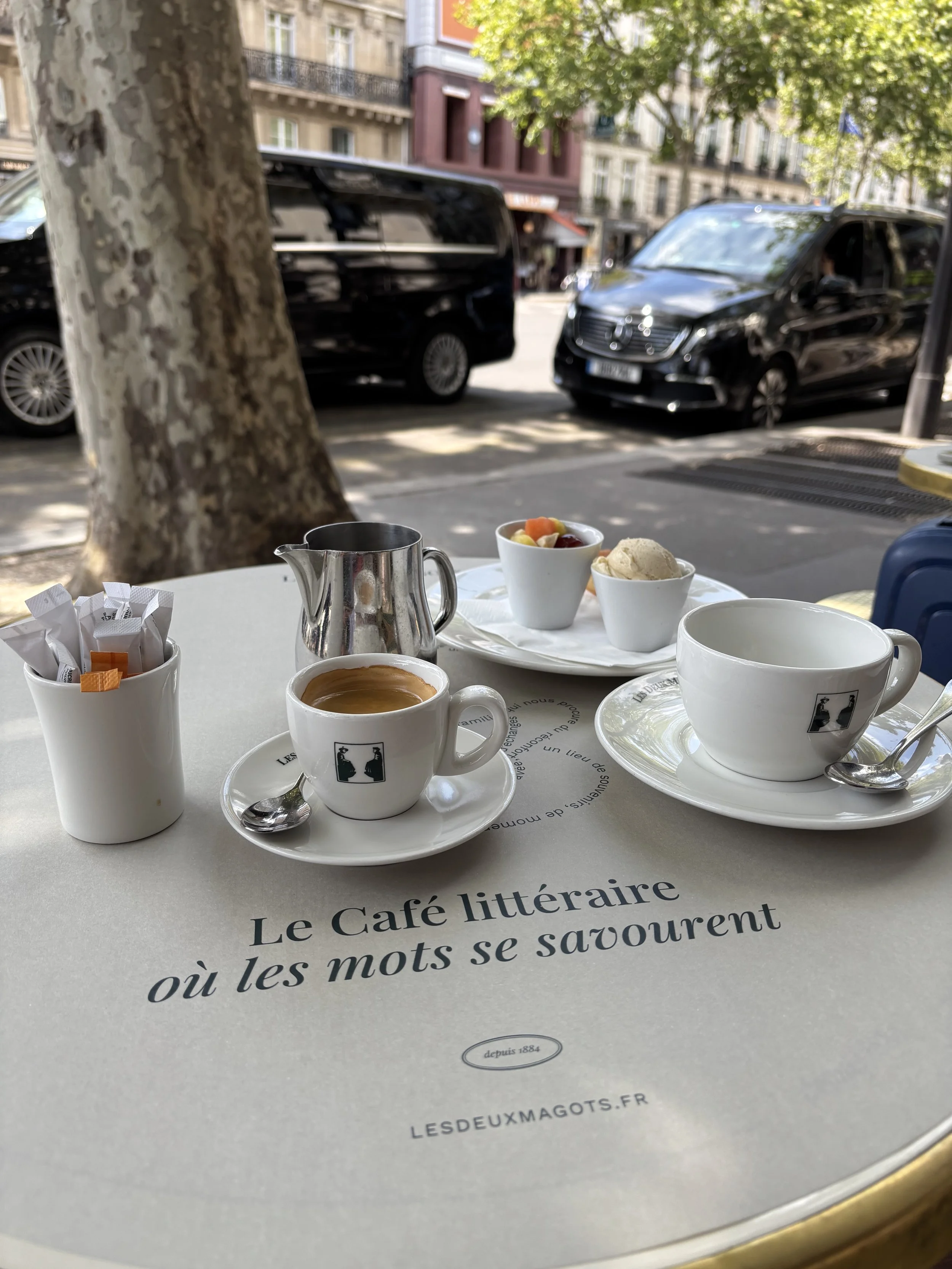
Having coffee at Les Deux Magots cafe in Paris.
The list of people who made Les Deux Magots their office, their salon, their thinking space, or their argument venue reads like a syllabus for a course in twentieth century cultural history.
Hemingway came here in the 1920s, during the years in Paris that he would later describe in A Moveable Feast, the memoir that made the city's café culture legendary for every reader who encountered it and produced, in its literary wake, generations of writers who arrived in Paris with a notebook and the specific hope of feeling what he described.
Simone de Beauvoir and Jean-Paul Sartre made Les Deux Magots, along with its neighbor and rival Café de Flore, fifty meters down the Boulevard Saint-Germain, the twin headquarters of existentialism.
It was a practical necessity: their apartment was cold, the café was heated, and the management brought coffee without being asked. De Beauvoir wrote significant portions of “Le Deuxième Sexe” (The Second Sex), the foundational feminist masterpiece published in 1949,at these tables. Sartre worked on “Being and Nothingness” in this room.
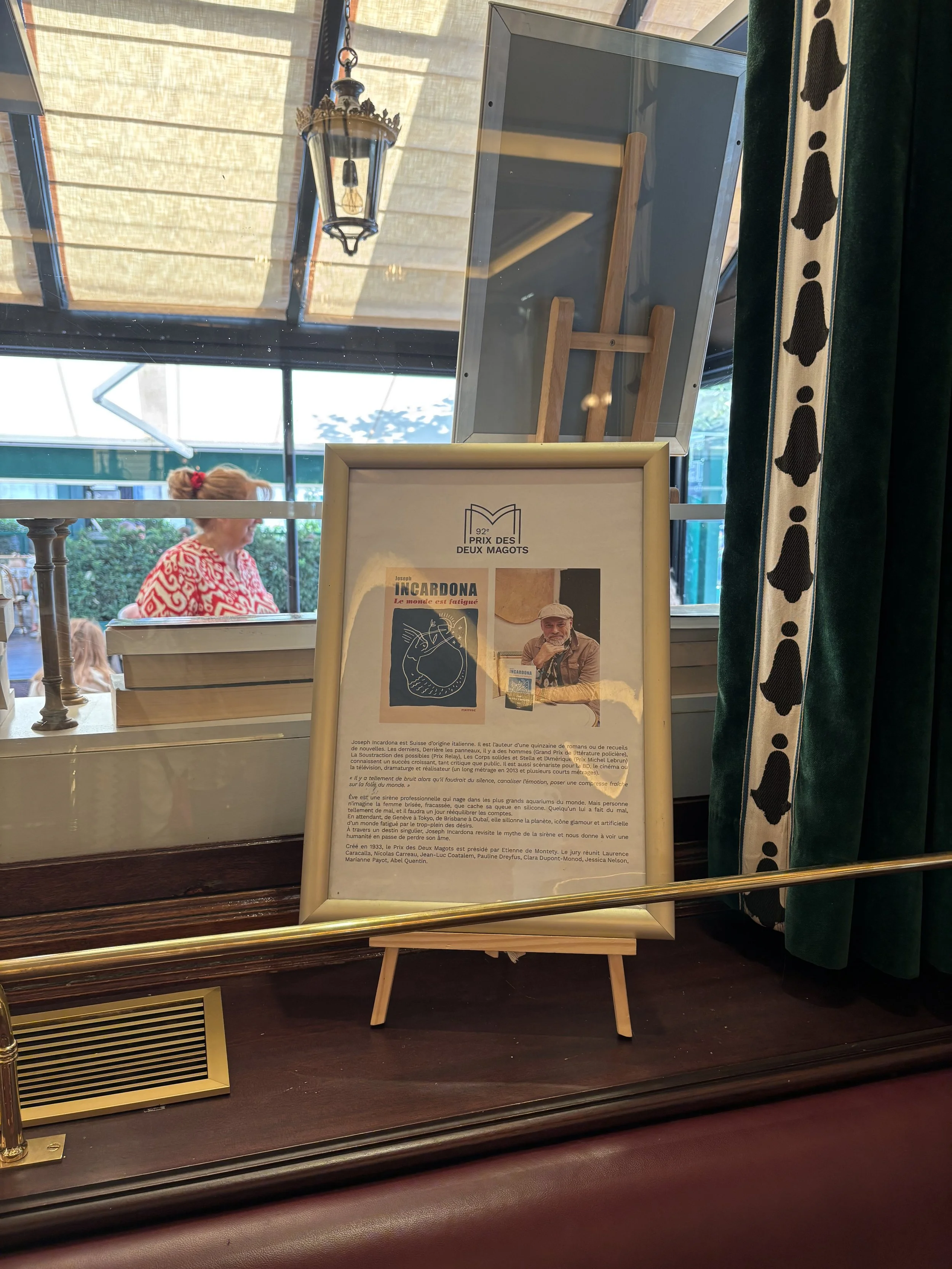
The winner of the annual prize of the cafe.
The philosophical framework that shaped the second half of the twentieth century was assembled, in part, over café crème at a marble table in the sixth arrondissement.
Picasso came here, as well as James Joyce, Bertolt Brecht, André Breton, the father of Surrealism, made it a meeting point for the movement.
Richard Wright, the American author of Native Son, came in the post-war years when Paris became the city of choice for Black American writers and artists escaping the racial violence of the United States.
The café was not simply a place where famous people drank coffee. It was a place where the culture of the twentieth century was made and argued into existence over small cups on small tables in a room where the two lacquered Chinese figures watched everything.
What It Is Now?
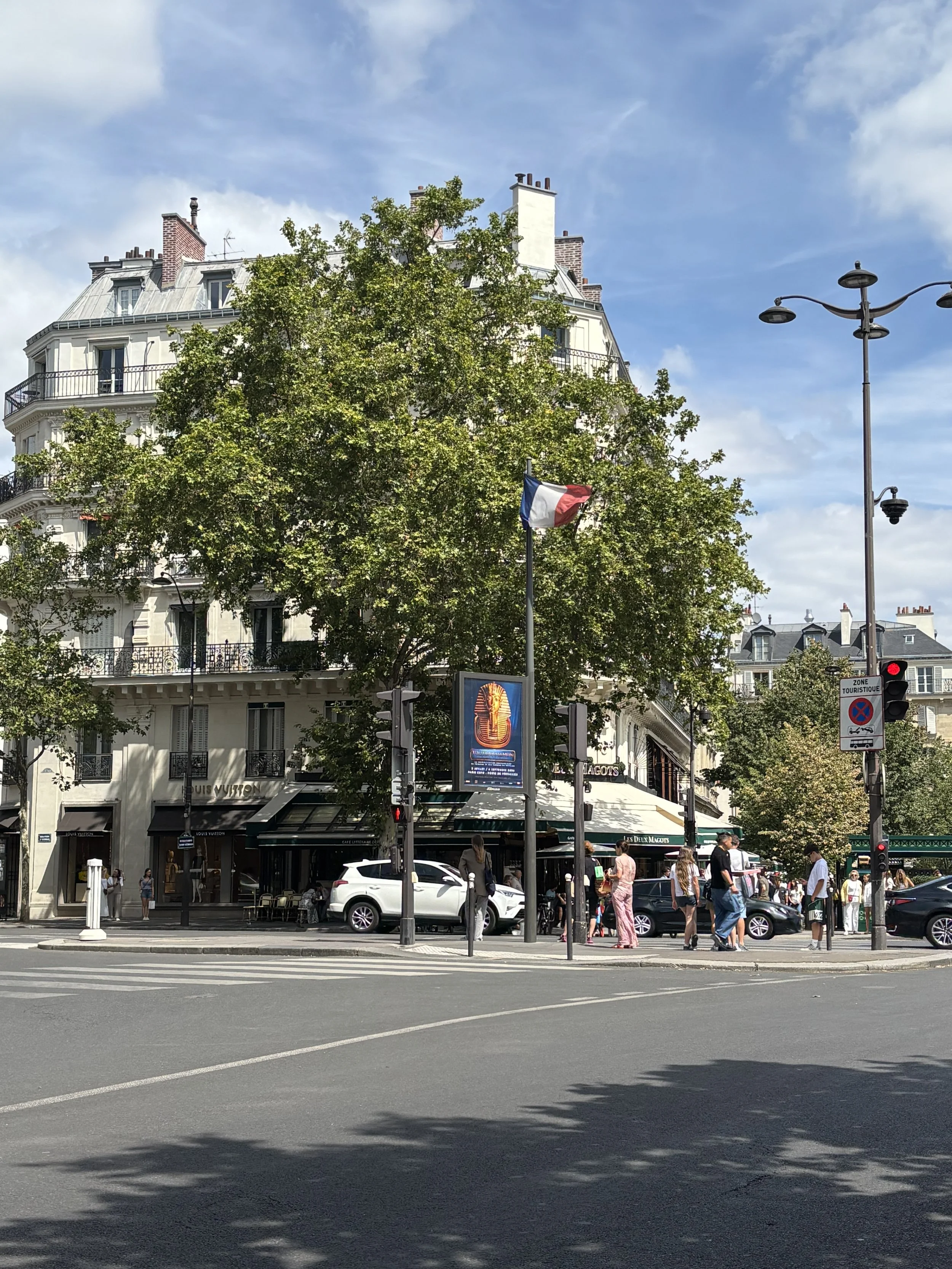
The street where Les Deux Magots is located.
Les Deux Magots is, in 2026, a tourist destination.
The regulars who nurse a single coffee for four hours writing existentialist philosophy have been replaced, in large measure, by visitors who arrive with a guidebook reference and a phone camera and stay for forty-five minutes.
The prices reflect the address, a café crème costs approximately €8, which is three times what the same coffee costs two streets away.
Knowing that, the café continues being exactly what it has always been, at the highest standard available, and to trust that the combination of history and quality is sufficient to justify the premium.
The waiters wear black waistcoats and long white aprons in the tradition that French café service has maintained for a century.
The Visit
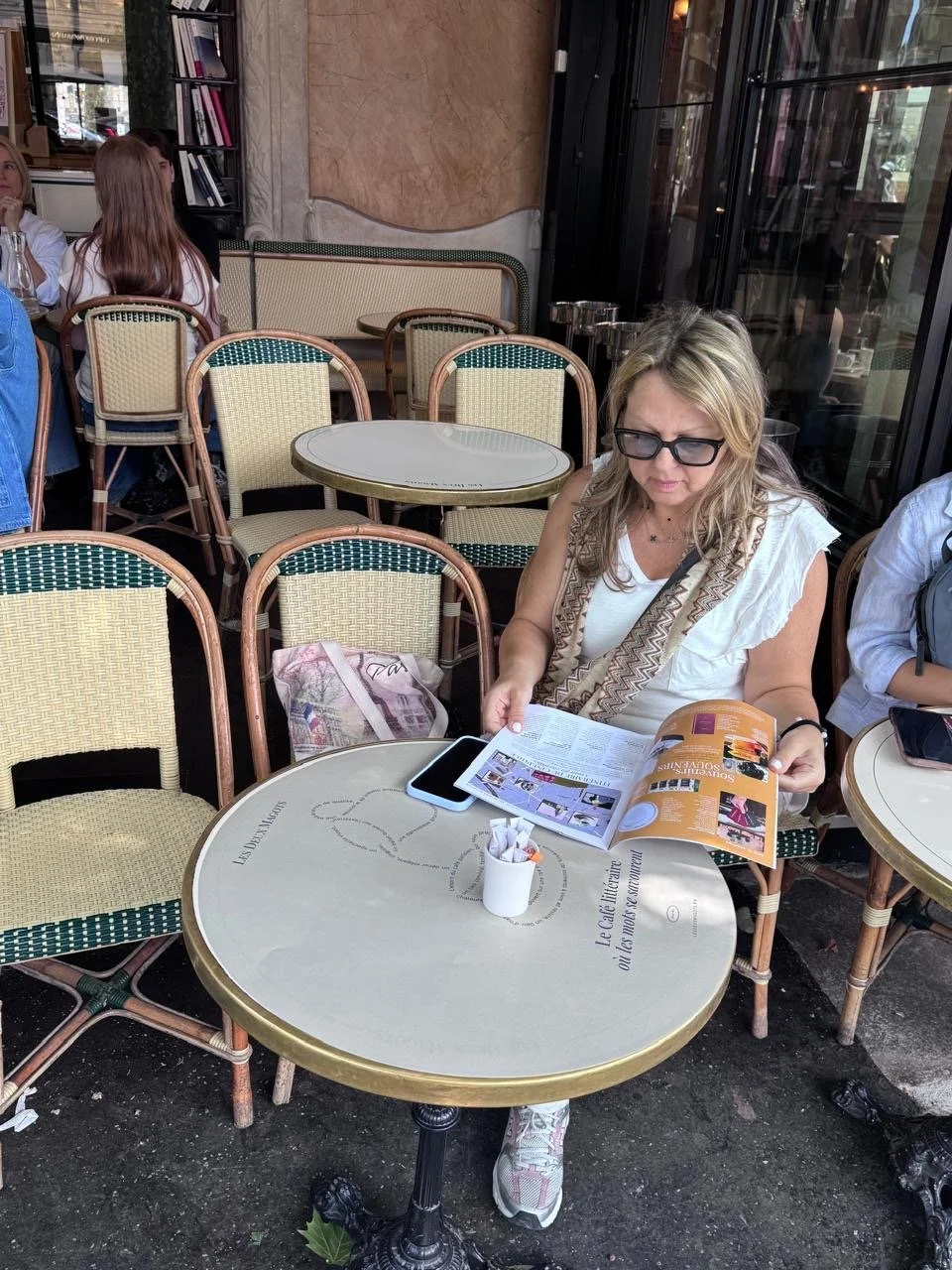
Norma at Les deux Magots cafe in Paris.
I arrived on a Wednesday morning in July when the Place Saint-Germain-des-Prés was still quiet as the locals who actually live in the neighborhood started leaving the city for holidays.
I sat outside, the terrace, with its green awning and its wicker chairs angled toward the square and the church of Saint-Germain-des-Prés beyond. I visited t he church and saw the list of names of people who died in the war for France.
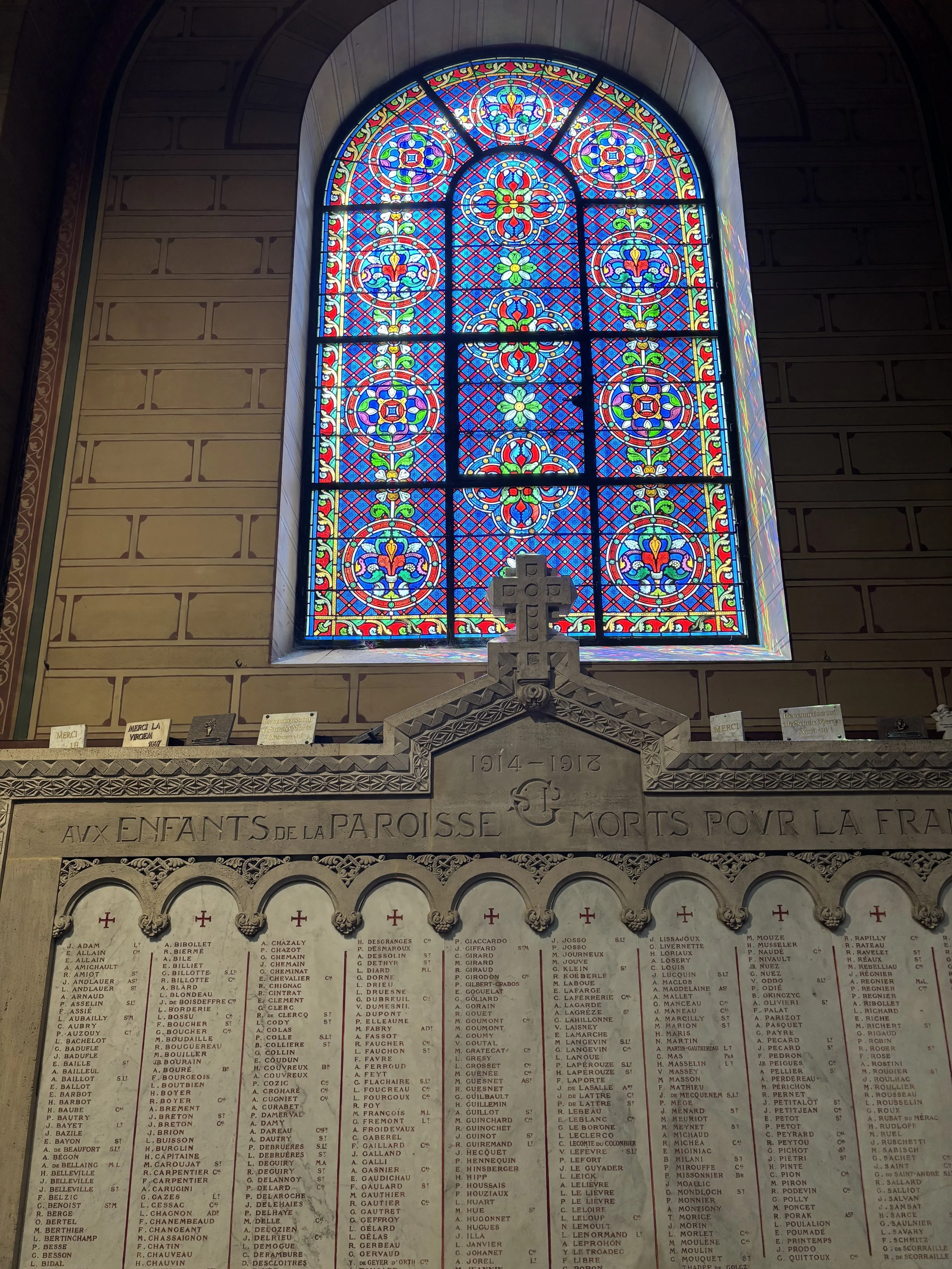
Inside the church of Saint-Germain-des-Prés.
I drank the coffee watching the square, letting the weight of the room settle around me in the way it does when you sit still long enough to feel it.
Final Word
Les Deux Magots is not Mediterranean, Saint-Germain-des-Prés is not the sea. But the café, the institution, the philosophy of the café as the place where the serious business of living is conducted, is Mediterranean in its deepest impulse.
The conviction that sitting at a table is not wasted time, that the conversation, the coffee, the unhurried hours, these are not interruptions to the work of living.
Et voilà! The Mediterranean Edit continues its tour in the heart of Europe!
Five Facts About Les Deux Magots :
1- The café has appeared in numerous films and remains one of the world's most photographed Parisian cafés.
2- Les Deux Magots played an important role in the development of Surrealism and later became closely associated with Existentialism.
3- Simone de Beauvoir also wrote much of her novel Les mandarins here; it won France's Prix Goncourt in 1954.
4- Since 1914, the cafe has been owned and operated by the same family across multiple generation.
5- In 1933, the cafe created the Prix des Deux Magots, a prestigious French literary prize that is still awarded annually.