Why Does Everyone Stop in Front of the Mona Lisa?
You will know the room before you reach it in the Louvre’s vast interior.
Not because of any sign or any architectural feature that distinguishes it from the hundreds of other rooms in the world's largest art museum. You will know it because of the crowd.
A specific kind of crowd, dense, phone-first, moving with the urgency of people who have to be somewhere and are in rush to document that moment.
The Salle des États. Room 711. The room that contains the Mona Lisa.
Let’s have a look what’s in there and why the crowds stop specifically there!
The Painting Itself
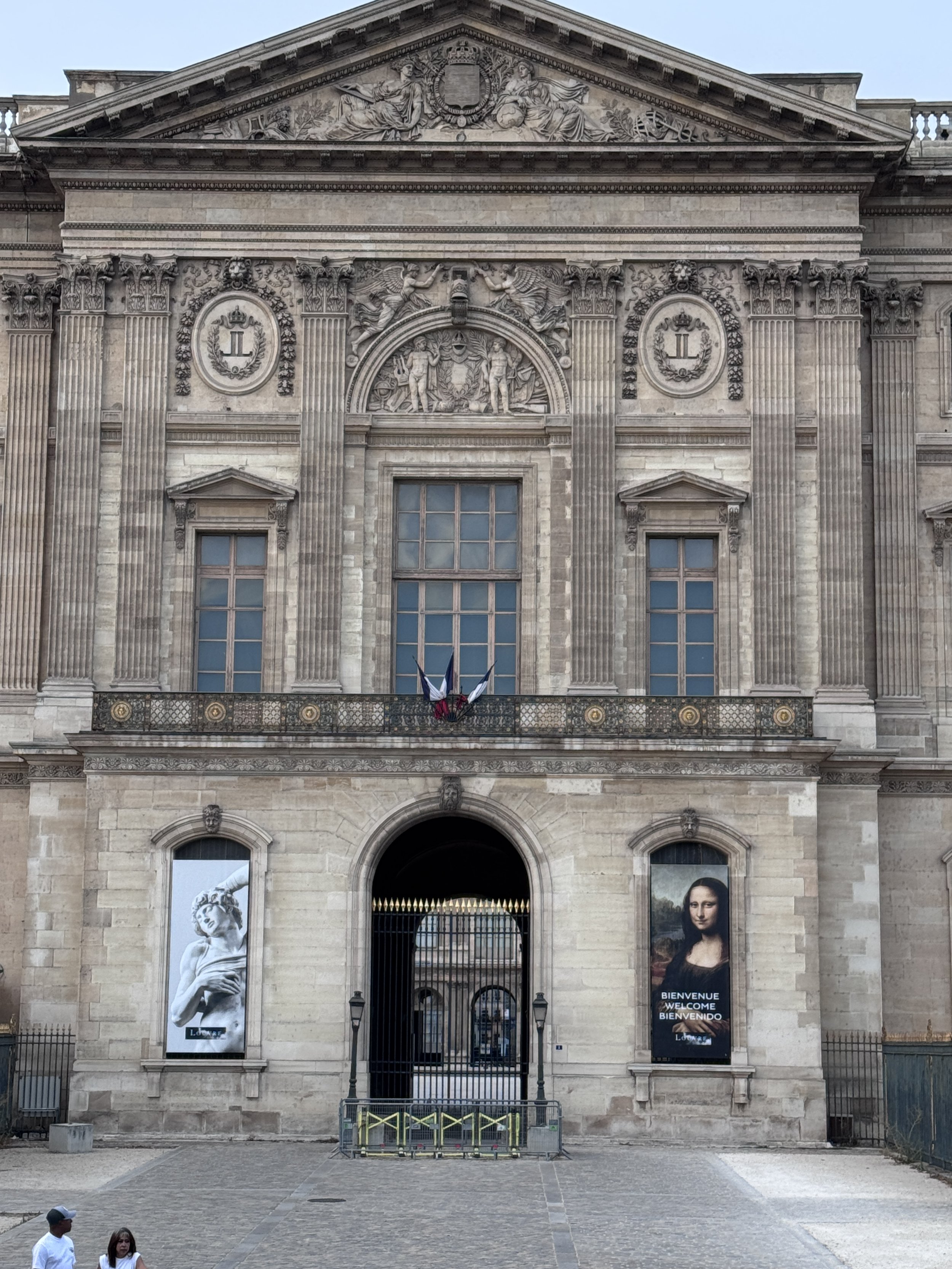
At one of the entrances of the Louvre museum in Paris.
No trip to Paris is complete without a visit to the Louvre. But the most visited room is the one where the most famous painting in the world is shown: The Mona Lisa.
The reason? It became, at a specific moment in modern history, a symbol of Art itself.
Walk toward it and you will feel the pull of it before you see a single brushstroke. The crowd thickens. The phones rise. The selfie sticks appear.
And then, through the heads and the screens and the outstretched arms, behind a barrier, behind bulletproof glass, approximately ten meters further away than you imagined, smaller than you imagined, here she is.
The Mona Lisa, La Gioconda in Italian, La Joconde in French, is a portrait painted in oil on poplar wood by Leonardo da Vinci, begun approximately in 1503 and worked on, according to some accounts, for as long as sixteen years. It measures 77 centimeters by 53 centimeters.
It is, by the standards of the Louvre's collection, a small painting but an extraordinary one.
Who really was the Mona Lisa?
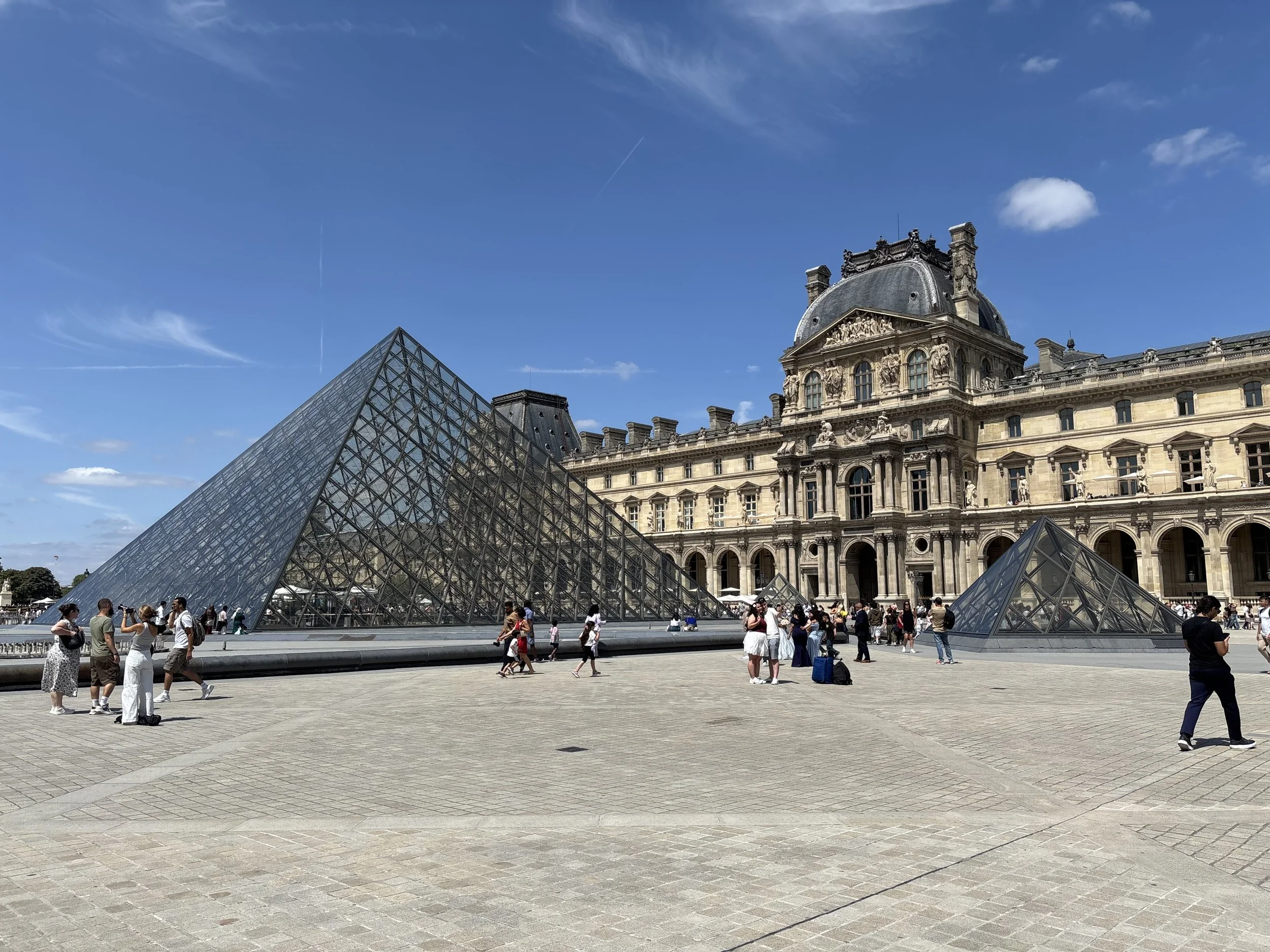
The Louvre museum in Paris.
The subject is believed to be Lisa Gherardini, the wife of a Florentine merchant named Francesco del Giocondo. She sits in a three-quarter pose against a landscape background, a technique that was, in 1503, a radical departure from the flat, profile-facing portraits that dominated European painting at the time.
Leonardo turned his subject to face you. He gave her a presence, a weight, a psychological interiority that portrait painting had not previously attempted at this level.
The sfumato technique, Leonardo's method of blending tones so gradually that the transitions between light and shadow have no visible edge, gives the face a quality that is genuinely difficult to describe and impossible to replicate exactly.
The corners of the mouth and the eyes are the most studied areas: both sit in zones of shadow where the sfumato is at its densest, which means that the expression changes depending on where your eye is focused.
Look at her eyes and she appears to be smiling. Look directly at her mouth and the smile becomes less certain. The expression is not fixed; it moves and responds to how you look at it.
This is optical science, applied by the greatest visual mind of the Renaissance with a precision that five hundred years of subsequent painting has never fully resolved.
What Happens in the Room
Here is what actually happens in Room 711, if you watch it rather than participate in it.
People enter; they see the crowd and the barrier. They see, above the heads and through the phones, the small painting behind the glass. They raise their own phone, they take a photograph, they lower the phone, check the photograph and move on.
The average time spent in front of the Mona Lisa is, according to various studies conducted at the Louvre over the years, somewhere between fifteen seconds and two minutes. For the majority of visitors, it is closer to fifteen seconds.
Fifteen seconds in front of a painting that took sixteen years to make!
Details to look at
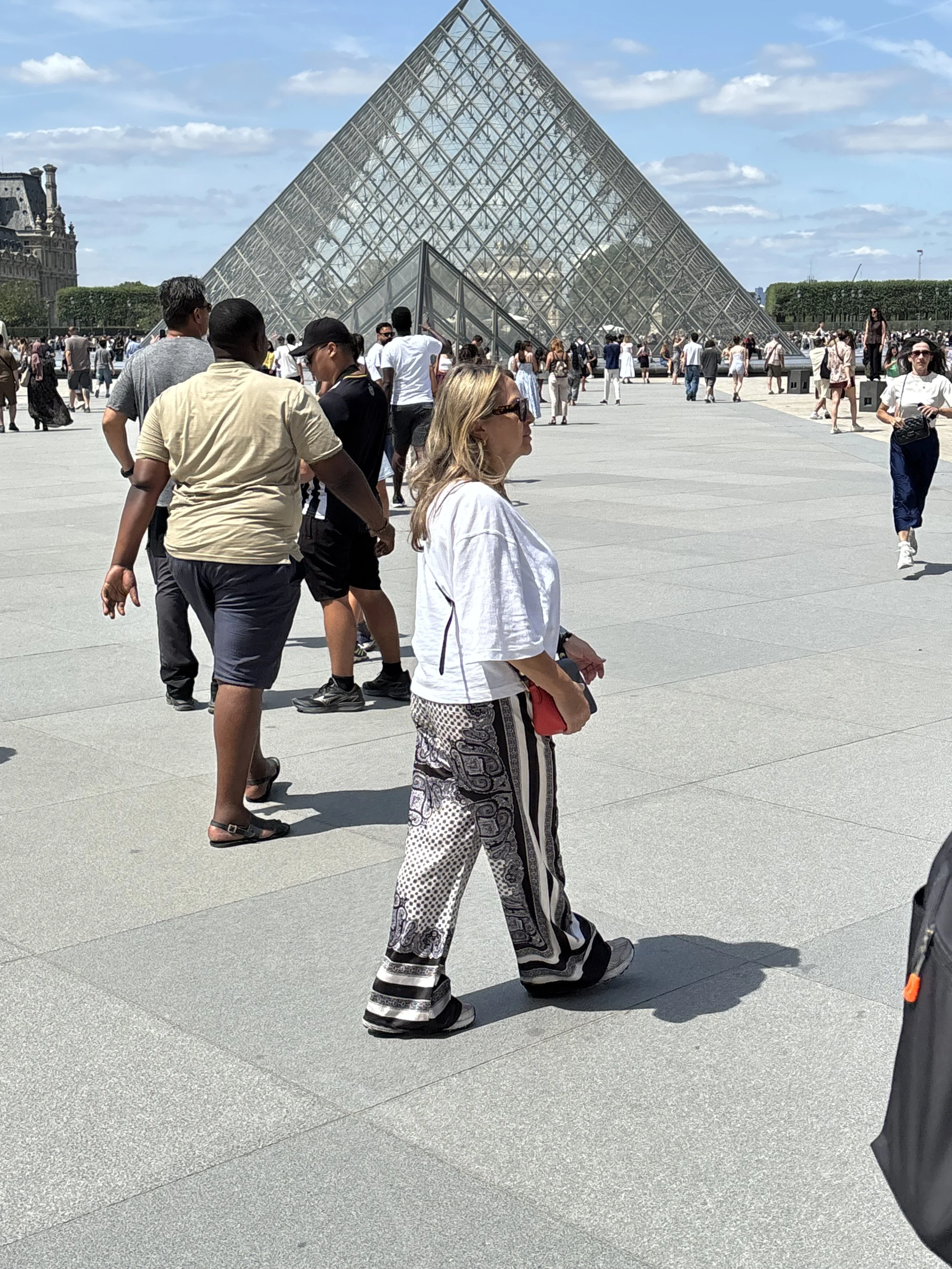
Norma in the front yard of the Louvre.
Most people, focused on the face, never look at the background of the paintimg, a dreamlike, slightly vertiginous landscape of mountains and water and winding paths that sits at different heights on the left and right sides of the painting.
Leonardo painted a landscape that does not obey the rules of the landscape you stand in.
The hands. Arguably the most technically accomplished hands in the history of portrait painting, the specific weight of one hand resting on the other, the fact that Leonardo painted the hands with the same psychological attention he gave the face.
They are not decorative. They are telling you something about the person attached to them.
And the smile, which is not, if you look at it long enough, a smile at all. It is a moment caught between expressions. A face in the process of becoming something, or ceasing to be something, the specific instant before or after a feeling completes itself.
That was the most visited part of the museum which contains approximately thirty-five thousand works across its permanent collection. On any given day, perhaps five thousand of those are on display.
Final word
That was an observation from a Mediterranean lens to an everyday ritual at the Louvre as visitors make their way regularly to the Mona Lisa.
Leaving the Louvre is much like closing the final page of a book, long after the galleries fade from view, the masterpieces remain etched in your memory, inviting reflection long after your visit has ended.
Et voilà! As our journey through Paris continues, one thing is certain: the City of Light always has another masterpiece waiting to be discovered!
Five Facts About the Louvre Museum:
1- The Louvre is the world's largest art museum and one of the most visited museums, welcoming millions of visitors every year.
2- Originally built as a fortress in 1190 under Philip II of France, it was later transformed into a royal palace before becoming a public museum.
3- The Louvre officially opened as a museum in 1793, during the French Revolution, with around 500 paintings on display, and now its collection includes more than 35,000 works of art.
4- The Louvre's collections represent civilizations from around the world, including Ancient Egypt, Greece, Rome, Mesopotamia, the Islamic world, and Europe.
5- The Louvre is a journey through over 8,000 years of human history, culture, and artistic achievement, making it one of the world's greatest cultural institutions.